



|
|
|
|
|
|
|
|
|
|
|


| . |  |
. |
|
|
|
 by Staff Writers Davis CA (SPX) Jul 21, 2011
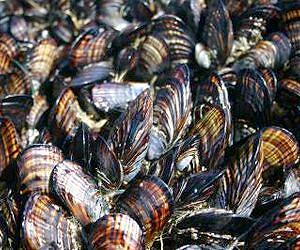
Ocean acidification, a consequence of climate change, could weaken the shells of California mussels and diminish their body mass, with serious implications for coastal ecosystems, UC Davis researchers will report July 15 in the Journal of Experimental Biology. California mussels (Mytilus californianus) live in beds along the western coast of the United States from Alaska to California. More than 300 other species share the beds or depend on the mussels in some way. "Because these mussels play such an ecologically critical role, a decline in their numbers could impact a wide range of other organisms," said Brian Gaylord, associate professor of evolution and ecology at the UC Davis Bodega Marine Laboratory and first author of the paper. Carbon dioxide, a greenhouse gas, is absorbed into the ocean, increasing its acidity. That acidity has increased by almost a third since the mid 18th century. Mussels spend the first part of their lives swimming freely as larvae, before settling onto coastal rocks to grow into adults. In the lab, Gaylord and his colleagues raised mussels from fertilization to the point where they were ready to settle, rearing them in both normal seawater and in water with two different conditions of elevated acidity. The acidity levels were based on projections by the Intergovernmental Panel on Climate Change, a Geneva-based scientific body established by the United Nations. One of the elevated acid levels assumed continued heavy use of fossil fuels; the other assumed a more optimistic scenario. Compared to those raised in normal seawater, the young mussels living in the more acid waters had smaller, thinner, weaker shells, and as much as a third less body mass. Weaker shells would make them more vulnerable to predators like crabs that crush their prey, as well as to carnivorous snails that drill through shells, Gaylord said. Smaller body size would make them more likely to dry out at low tide and less able to withstand the energetically expensive process of metamorphosis from a free-living larva to a settled shellfish. "Together these trends suggest that we're likely to see lower survivorship of young mussels as they return to shore," Gaylord said. Although not an important fishery, the California mussel is a vital coastal species because so many other marine creatures depend on it for food and habitat. Coauthors of the study are: Associate Professor Eric Sanford, researcher Elizabeth Lenz, research technician Kirk Sato and graduate student Annaliese Hettinger, all of the UC Davis Department of Evolution and Ecology and Bodega Marine Lab; Assistant Professor Tessa Hill and technician Lisa Jacobs, of the UC Davis Department of Geology and Bodega Marine Lab; and Ann Russell, associate researcher at the UC Davis Department of Geology.
Related Links University of California - Davis Water News - Science, Technology and Politics
|
|
|
| The content herein, unless otherwise known to be public domain, are Copyright 1995-2014 - Space Media Network. AFP, UPI and IANS news wire stories are copyright Agence France-Presse, United Press International and Indo-Asia News Service. ESA Portal Reports are copyright European Space Agency. All NASA sourced material is public domain. Additional copyrights may apply in whole or part to other bona fide parties. Advertising does not imply endorsement,agreement or approval of any opinions, statements or information provided by Space Media Network on any Web page published or hosted by Space Media Network. Privacy Statement |
 del.icio.us
 Digg
Digg Reddit
 Google