|
 |
 |
 |
 |
 |
 |
 |
 |
 |

| . |  |
. |
In The Stars: Stellar Size Limits
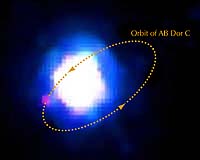
Washington DC (UPI) Feb 3, 2005 The sun, source of Earth's warmth and weather and life's energy, looms as the giant of the solar system. About 870,000 miles in diameter, it can hold more than a million Earths within its sphere. Among the nine local planets, Jupiter, nearly 400 million miles away at its closest, reigns supreme, a 90,000 mile-wide ball of gas with a mass equaling some 420 Earths. These two heavenly bodies seem huge from 8,000 mile-wide Earth, but based on what astronomers have been able to determine about the rest of the galaxy, both seem utterly ordinary -- puny even. Based on painstaking research, astronomers have discovered planets orbiting other stars, most bigger than Jupiter and some up to 10 times the Jovian diameter. Mighty big, but still not enough to join the stellar club. For its nuclear furnace to switch on to produce starlight, a body must grow considerably larger -- about 100 times the mass of Jupiter. Then there are so-called failed stars, known as brown dwarfs, which run 75 times of Jupiter's mass or so -- not enough to ignite. AB Dor C is one such object. Astronomers working at the European Southern Observatory in Chile found AB Dor C last month using a clever detection technique. Because even the biggest existing telescopes are not powerful enough to capture an image of a brown dwarf, let alone a planet, astronomers must look for the objects indirectly. The best place, it turns out, is in binary star systems. There, they can measure how much the motions of visible companions are disturbed by the gravitational influence of their unseen partners -- whether brown dwarfs, neutron stars or black holes. Using exquisitely sensitive motion detectors, astronomers can determine how far away a dark binary companion is from its parent star and how much it weighs. There is one requirement, however: Astronomers searching for dark stellar objects need to look for bright young binary companions, because their light is brightest while they are young, and the brighter the starlight, the easier it is to detect the shifts in brightness caused by gravitationally induced wobble. The ESO team, using the observatory's Very Large Telescope, found the dark companion orbiting the star at a distance about two and a half times farther than Earth's orbit around the sun and completing each irregular orbit in about 11.75 years. Based on those two bits of data, the astronomers then determined AB Dor C's mass at about 93 times that of Jupiter -- or very near the threshold for igniting. Actually, the discovery has created a bit of controversy in astronomy circles. Previous estimates had placed the upper size limit of brown dwarfs at about 88 times Jupiter's mass. Anything bigger was supposed to switch on as a full-fledged star, but AB Dor C has confounded that theory. Meanwhile, researchers at the University of Michigan and Cambridge University in England have been working to estimate the upper limit of stellar mass and have produced an amazing result. Examining a wide range of star clusters within the Milky Way, the teams concluded that stars can grow "only" to about 160 times the mass of the sun -- give or take 40 solar masses. "Only" leaves a lot of room. Take the great star Betelgeuse, which sits on the right shoulder of Orion, the hunter, in the winter night sky. One of the largest stars known, its radius is 630 times bigger than the sun's, enough to smother the four inner planets and reach more than halfway to Jupiter if it anchored this solar system. Betelgeuse shines extremely brightly -- maybe 60,000 times brighter than the sun. Even though it is about 425 light-years away, if it turns out to be large enough to consume itself in a supernova explosion, it could threaten life on Earth. Yet, for all its superlatives, its mass is only about 15 times the sun's, so Betelgeuse is less than 10 percent of the maximum theoretical size for stars. This fact makes the finding about maximum stellar size somewhat mind boggling. If the calculations prove true, there could be giants out there with diameters that would swallow the entire solar system, and with masses that could secure the orbits of hundreds or even thousands of planets. What makes one star grow so large while another fails to make the cut? At this point, astronomers acknowledge, no one yet knows. "The question about why stars have the masses that they do is fundamental, and our lack of understanding shows that we really don't know some basics of how stars form," said Sally Oey, an assistant professor of astronomy at Michigan, in a statement accompanying the release of the team's findings. "My African violets won't grow any bigger now because their roots are totally taking up the maximum room in the pot," she said. "If I repotted them they would grow larger. Are the stars maxed out because the parent clouds are limiting them, or because, like a whale in the sea, there's something else physical about stars themselves that limits the size?" All rights reserved. � 2004 United Press International. Sections of the information displayed on this page (dispatches, photographs, logos) are protected by intellectual property rights owned by United Press International. As a consequence, you may not copy, reproduce, modify, transmit, publish, display or in any way commercially exploit any of the content of this section without the prior written consent of United Press International. Related Links SpaceDaily Search SpaceDaily Subscribe To SpaceDaily Express  Astronomers Take Revealing Peek At Star Factory
 Baltimore MD (SPX) Jan 17, 2005
Using NASA's orbiting Far Ultraviolet Spectroscopic Explorer, a team of astronomers from The Johns Hopkins University and elsewhere has taken an unprecedented peek beneath the "skirts" of the tunic-clad Orion the Hunter and come away with observations that may lead to enhanced knowledge of how interstellar dust absorbs and scatters ultraviolet starlight.
|
|
| |||||||||
| The content herein, unless otherwise known to be public domain, are Copyright 1995-2016 - Space Media Network. All websites are published in Australia and are solely subject to Australian law and governed by Fair Use principals for news reporting and research purposes. AFP, UPI and IANS news wire stories are copyright Agence France-Presse, United Press International and Indo-Asia News Service. ESA news reports are copyright European Space Agency. All NASA sourced material is public domain. Additional copyrights may apply in whole or part to other bona fide parties. Advertising does not imply endorsement, agreement or approval of any opinions, statements or information provided by Space Media Network on any Web page published or hosted by Space Media Network. Privacy Statement All images and articles appearing on Space Media Network have been edited or digitally altered in some way. Any requests to remove copyright material will be acted upon in a timely and appropriate manner. Any attempt to extort money from Space Media Network will be ignored and reported to Australian Law Enforcement Agencies as a potential case of financial fraud involving the use of a telephonic carriage device or postal service. |