|
 |
 |
 |
 |
 |
 |
 |
 |
 |

| . |  |
. |
|
SKYNIGHTLY
Saturn Tilts Its Hat WithJupiter Close By
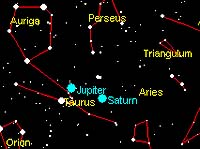
Appearing like two glittering jewels hanging in the night sky, the giant planets Jupiter and Saturn are heading toward their closest approach to Earth, an event astronomers call "opposition." At opposition, a planet lies opposite the Sun in Earth's sky. The planet rises at sunset, reaches its highest point in the sky at midnight, and sets at dawn. Saturn comes to opposition on Sunday, November 19, and Jupiter comes to opposition on Monday, November 27. At closest approach, Jupiter will be about 376 million miles from Earth, while Saturn will be twice as far -- about 756 million miles If you envision the solar system as a giant race track, Earth is moving in an inner lane. Jupiter and Saturn come to opposition when the faster moving Earth overtakes and passes the outer planets. "Whether using the naked eye or a telescope, the best time to observe Jupiter and Saturn is when they come closest to Earth," says Robert Naeye, editor of Mercury magazine, which is published by the Astronomical Society of the Pacific (ASP). "Even with a small telescope, you can easily see Jupiter's four largest moons, along with bands in its upper atmosphere. Seeing Saturn's rings with a telescope is a piece of cake." "Both planets will remain prominent in the night sky throughout November and December," adds James White, the executive director of the ASP. "Jupiter is by far the brightest object in the southeastern part of the sky in the early evening. Saturn is bright, although it's not as bright as Jupiter. It lies to the upper right of Jupiter in the early evening." Although Saturn is not as bright as Jupiter because Jupiter is closer to Earth, this is the brightest that Saturn has been in about 25 years. Saturn is particularly bright because it will be closer to Earth during this opposition than during many previous oppositions, and because its rings are tipped 24 degrees to our line of sight. Saturn's rings haven't been tilted this much since 1990, and at that time, Saturn was much farther from Earth. People looking through a telescope should try to spot the Cassini Division, a narrow, dark band in the rings that separates the outer A ring from the brighter B ring. An observer using a large telescope in a dark sky far from city lights can generally see up to seven of Saturn's moons at a given time. This is also an above average Jupiter opposition. Parallel bands in Jupiter's upper atmosphere are the highlights of a telescopic show. Telescopic observers can also watch the dance of Jupiter's four largest moons -- Io, Europa, Ganymede, and Callisto -- as they orbit the gas giant planet. Observers with good telescopes and ideal observing conditions can sometimes see Jupiter's Great Red Spot, a giant storm system twice the size of Earth. Besides Jupiter and Saturn, Venus presents a dazzling spectacle in late November and December. Venus is as an extremely bright point of light in the southwest around sunset. The planet will appear very close (about 2 degrees) to the Moon on November 29, an event astronomers call a "conjunction." The Astronomical Society of the Pacific is the nation's oldest and largest general astronomy society. Founded in 1889 in San Francisco, and still headquartered there today, the ASP has grown into an international society. Its membership is spread over all 50 states and 70 countries and includes professional and amateur astronomers, science educators of all levels, and the general public. The ASP publishes the bimonthly Mercury magazine, a quarterly teachers' newsletter called universe in a Classroom, and a technical journal for professional astronomers. Related Links Astronomical Society of the Pacific SpaceDaily Search SpaceDaily Subscribe To SpaceDaily Express 
SKYNIGHTLY New England Sky Watchers Can Catch Leonids Glimpses Nov 17 Huntsville - Nov. 8, 2000
Sky watchers along the North American east coast should be able to catch tantalizing glimpses of this years Leonids meteor showers.Three peak times for the showers are forecast for the East Coast -- Nov. 17 at about 3 am EST and again at 11pm EST and Nov. 18 at about 3am EST.
|
|
| |||||||||
| The content herein, unless otherwise known to be public domain, are Copyright 1995-2016 - Space Media Network. All websites are published in Australia and are solely subject to Australian law and governed by Fair Use principals for news reporting and research purposes. AFP, UPI and IANS news wire stories are copyright Agence France-Presse, United Press International and Indo-Asia News Service. ESA news reports are copyright European Space Agency. All NASA sourced material is public domain. Additional copyrights may apply in whole or part to other bona fide parties. Advertising does not imply endorsement, agreement or approval of any opinions, statements or information provided by Space Media Network on any Web page published or hosted by Space Media Network. Privacy Statement All images and articles appearing on Space Media Network have been edited or digitally altered in some way. Any requests to remove copyright material will be acted upon in a timely and appropriate manner. Any attempt to extort money from Space Media Network will be ignored and reported to Australian Law Enforcement Agencies as a potential case of financial fraud involving the use of a telephonic carriage device or postal service. |