| . |  |
. |
| . | |
. |


Thumbs Up For 60-Second Firing
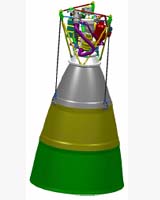
Hot-firing tests of the new Vinci cryogenic upper-stage engine reached a new high on Wednesday with a successful test lasting 60 seconds. This is the longest duration test since trials began and the first carried out under full test conditions. To meet these conditions the turbo-pumps ran at full revolution and full pressure was reached in both the thrust chamber and in the turbo-pumps. During previous tests, the engine was shut down at between 25% to 50% pressure level, well before these conditions were reached, to protect the hardware. Vinci, developed under ESA's Ariane-5 Plus launcher programme, is a new upper-stage launcher engine. This re-ignitable cryogenic engine uses a more efficient expander cycle, which does not require a gas generator to drive its two turbo-pumps: one for liquid hydrogen (LH2) and one for liquid oxygen (LOX). Vinci will provide 18 tonnes of thrust in vacuum with a specific impulse of 465 sec. The technologies involved in developing this new upper stage engine are of great importance for future developments in the European propulsion sector. Wednesday's ignition was as smooth as in previous tests and when the supersonic flame front stabilised it was thumbs up from all present for a long duration run. Vinci behaved as predicted and performed flawlessly; adding an important milestone to the engine's development. "With this test of over 60 seconds we have achieved all our goals and are confident that we are on the right track to have a new upper-stage engine for future upgrades of the Ariane-5 launcher," said ESA Vinci Project Manager, Uwe Berkes Since the first test in May this year, lasting just one second, the length of the firing has been gradually increased until full establishment of the combustion process and stable 60 seconds run in Wednesday's trial. This test, with all systems running at nominal conditions and for a longer duration, provided the certainty that the design objectives have been achieved. "The fact that we were able to perform a long duration test after only a few initial runs with this new launcher engine is a remarkable European success. Particularly as the tests have been performed in the new DLR test facility, which is of high complexity and unique in Europe" said Jean-Marc Ruault of the French Space Agency, CNES Vinci Project Manager. Vinci engine M-1 will now be taken out of the test chamber to undergo detailed inspection for characterisation of its mechanical status and validation of lifetime predictions. Data gathered during the tests will also be evaluated during the next few weeks by the industry teams involved in the project. From September a second development engine, Vinci M-2, will be used for further testing and characterisation of engine behaviour. This second engine has been modified based on experience gained during manufacturing, integration and previous tests. The trials are being carried out in the new P4.1 test stand of the German Space Agency (DLR) in Lampoldshausen, Germany; a facility built to perform hot-firing tests under near-realistic space conditions. It is unique in Europe both for its size and because it allows continuous hot-firing tests of upper-stage engines. The test stand can provide up to 20 tonnes of thrust at a pressure level of below 200 mbar and typically at 60 mbar. Maximum test duration is 10 minutes. "All our thanks go to the European industry team around the prime contractor SNECMA for the constant effort to reach this milestone, and to DLR for establishing the test facility," said Ruault. Related Links Launchers at ESA SpaceDaily Search SpaceDaily Subscribe To SpaceDaily Express  World's Largest Rocket Contest Issues New Challenge for Participants
 Arlington VA (SPX) Jul 25, 2005
Student rocketeers will have a doubly difficult task next year after the Team America Rocketry Challenge revamped the rules to include both height and time aloft for the first time.
|
|
| |||||||||
| The content herein, unless otherwise known to be public domain, are Copyright 1995-2016 - Space Media Network. All websites are published in Australia and are solely subject to Australian law and governed by Fair Use principals for news reporting and research purposes. AFP, UPI and IANS news wire stories are copyright Agence France-Presse, United Press International and Indo-Asia News Service. ESA news reports are copyright European Space Agency. All NASA sourced material is public domain. Additional copyrights may apply in whole or part to other bona fide parties. Advertising does not imply endorsement, agreement or approval of any opinions, statements or information provided by Space Media Network on any Web page published or hosted by Space Media Network. Privacy Statement All images and articles appearing on Space Media Network have been edited or digitally altered in some way. Any requests to remove copyright material will be acted upon in a timely and appropriate manner. Any attempt to extort money from Space Media Network will be ignored and reported to Australian Law Enforcement Agencies as a potential case of financial fraud involving the use of a telephonic carriage device or postal service. |