| . |  |
. |
| . | |
. |


|
RADARSAT Guides Chinese IceBreaker Out Of Trouble 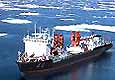 Richmond - August 9, 1999 - RADARSAT International (RSI) and the Canadian Ice Service (CIS) are pleased to announce the successful delivery of the first of several RADARSAT-derived ice maps being provided to a Chinese Polar Expedition.
The images are being sent electronically to aid in navigation of the Expedition's icebreaker, the Xue Long, through ice-encumbered Arctic waters, demonstrating the fast processing and delivery capabilities as well as sea-ice navigation application of Canada's RADARSAT-1 satellite program. The Expedition began on July 1, when Xue Long left Shanghai intent on reaching 82 deg North. However, only two days before delivery of this RADARSAT scene, the icebreaker was left stranded due to thick fog and ice conditions. The scene was collected at Canada's Gatineau Satellite Station (GSS) at 18:00 on July 17th, processed and transferred to the Canadian Ice Service (CIS) where ice maps were produced and made available with a brief description by 21:40 for the icebreaker personnel -- less than four hours after reception. Thereafter, the icebreaker was able to manoeuvre out of the area blocked by ice, which measured on average in excess of eight metres wide, and the crew decided to change its route significantly. The Expedition's new goal is to reach roughly 75 deg North. Mr. Chen Li Qi, Director of Arctic and Antarctic Administation and Chief Scientist of the Chinese Arctic Mission Group, said, "We believe that high technology relating to Arctic sea-ice analysis provided by RADARSAT is of great help to the mission. With over ten years' experience of ice analysis and forecast, Chinese scientists should have no technical difficulties in using images and information transferred from Canada." CIS is highly experienced in ice analysis and mapping for navigation in the Arctic regions of Canada. Its staff analyzes more than 4000 RADARSAT images each year, extracting information such as ice concentration, thickness, age, shape, and location. Since the launch of RADARSAT-1 in 1995, this type of analyses has contributed to a reduced sailing time between North America and Europe -- from 21 days to 7. Sharon Jeffers, Ice Forecaster at CIS who created this RADARSAT ice map, commented, "We've come a long way towards assisting shipping in Arctic regions since the first European explorers tried to find the Northwest passage." As the world's first operationally-oriented radar satellite, RADARSAT is equipped with an advanced synthetic aperture radar (SAR). RADARSAT's unique capabilities, including eight metre resolution and near-real time services, open a vast new array of applications around the world. Established in 1989, RSI is a wholly-owned subsidiary of MacDonald Dettwiler and Associates and has its headquarters in Richmond, British Columbia, Canada. RSI is a world leader in providing satellite imagery and derived products and services for decision making on global issues ranging from agriculture and ice reconnaissance to coastline mapping and disaster management. RSI's product line features RADARSAT-1, the world's most powerful commercial radar-based Earth-observation satellite. After the launch of RADARSAT-2 in early 2002, RSI will distribute this satellite's imagery, as well, under a contract with ORBIMAGE. Other products currently offered by RSI include data from IRS, ERS, SPOT, LANDSAT, and JERS satellites. Although summer is well underway in southern Canada, in the waters of the western Arctic Ocean (Chukchi Sea) it is only just beginning. This is made clear by the tone change in the RADARSAT image that indicates the snow pack on the moving pack ice is beginning to melt. This is the first stage in the process of ice decay for first-year ice. Areas of lower ice concentration are visible at the ice edge and around Wrangel Island, however for the most part the ice pack ice still covers roughly 95% of the water surface. Shear lines occur where the pack ice on either side of the line is moving at different speeds. A small area of open water (ice concentration less than one tenth) is visible in the bottom right hand side of the image.
RadarSat Reports At SpaceDaily
|
|
| ||||||||
| The content herein, unless otherwise known to be public domain, are Copyright 1995-2016 - Space Media Network. All websites are published in Australia and are solely subject to Australian law and governed by Fair Use principals for news reporting and research purposes. AFP, UPI and IANS news wire stories are copyright Agence France-Presse, United Press International and Indo-Asia News Service. ESA news reports are copyright European Space Agency. All NASA sourced material is public domain. Additional copyrights may apply in whole or part to other bona fide parties. Advertising does not imply endorsement, agreement or approval of any opinions, statements or information provided by Space Media Network on any Web page published or hosted by Space Media Network. Privacy Statement All images and articles appearing on Space Media Network have been edited or digitally altered in some way. Any requests to remove copyright material will be acted upon in a timely and appropriate manner. Any attempt to extort money from Space Media Network will be ignored and reported to Australian Law Enforcement Agencies as a potential case of financial fraud involving the use of a telephonic carriage device or postal service. |

