|
 |
 |
 |
 |
 |
 |
 |
 |
 |

| . |  |
. |
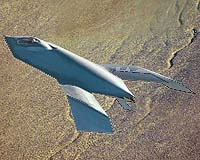
Bird of Prey Delivers Tech Feed
Boeing has unveiled the "Bird of Prey," a technology demonstrator that pioneered breakthrough low-observable technologies and revolutionized aircraft design, development and production. The once highly classified project ran from 1992 through 1999, and was revealed because the technologies and capabilities developed have become industry standards, and it is no longer necessary to conceal the aircraft's existence. In addition to proving many new stealth concepts, the Bird of Prey program demonstrated innovative rapid prototyping techniques. Developed by the Boeing Phantom Works advanced research-and-development organization, the Bird of Prey was among the first to initiate the use of large, single-piece composite structures; low-cost, disposable tooling; and 3-D virtual reality design and assembly processes to ensure the aircraft was affordable to build as well as high-performing. Fully funded by Boeing, the Bird of Prey project costs $67 million. A subsonic, single-seat technology demonstrator, the aircraft completed 38 test flights as part of its flight-demonstration program. Its first flight took place in fall 1996. Bird of Prey has a wingspan of approximately 23 feet and a length of 47 feet, and weighs nearly 7,400 pounds. Powered by a Pratt & Whitney JT15D-5C turbofan engine, the Bird of Prey has an operational speed of 260 knots and a maximum operating altitude of 20,000 feet. "Early investments in technology demonstration projects such as Bird of Prey have positioned Boeing to help shape our industry's transformation," said Jim Albaugh, president and CEO of Boeing Integrated Defense Systems. "With this aircraft, we changed the rules on how to design and build an aircraft, and what we've learned is enabling us to provide our customers with affordable, high-performing products. "Projects such as Bird of Prey have provided the catalyst for integrating speed, agility and reduced cost into the processes we employ to introduce new commercial and military systems to market." Boeing's current development of the X-45A Unmanned Combat Air Vehicle, or UCAV, technology demonstrator draws directly on its Bird of Prey experience. Some aspects of the UCAV's innovative radar-evading design, such as its shape and inlet, were developed from this project. Together, Boeing Phantom Works and Boeing Integrated Defense Systems are developing UCAV for the Defense Advanced Research Projects Agency, or DARPA, and the U.S. Air Force. "The success of the Bird of Prey is a testament to the shared commitment of Boeing and the Air Force to pioneering innovative methods to drive down costs and improve performance," said George Muellner, senior vice president of Air Force Systems for Boeing Integrated Defense Systems. "This project stressed affordability as much as performance and quality, and is one of many that we are using to define the future of aerospace." Related Links Bird's Of Prey MultiMedia Selection at Boeing SpaceDaily Search SpaceDaily Subscribe To SpaceDaily Express  Northrop Grumman Unveils Concept For Quiet Supersonic Aircraft
 El Segundo - Oct 1, 2002
Northrop Grumman Corporation's Integrated Systems sector has unveiled a design for an efficient and capable long-range supersonic cruise aircraft that would operate with a less intense sonic boom.
|
|
| |||||||||
| The content herein, unless otherwise known to be public domain, are Copyright 1995-2016 - Space Media Network. All websites are published in Australia and are solely subject to Australian law and governed by Fair Use principals for news reporting and research purposes. AFP, UPI and IANS news wire stories are copyright Agence France-Presse, United Press International and Indo-Asia News Service. ESA news reports are copyright European Space Agency. All NASA sourced material is public domain. Additional copyrights may apply in whole or part to other bona fide parties. Advertising does not imply endorsement, agreement or approval of any opinions, statements or information provided by Space Media Network on any Web page published or hosted by Space Media Network. Privacy Statement All images and articles appearing on Space Media Network have been edited or digitally altered in some way. Any requests to remove copyright material will be acted upon in a timely and appropriate manner. Any attempt to extort money from Space Media Network will be ignored and reported to Australian Law Enforcement Agencies as a potential case of financial fraud involving the use of a telephonic carriage device or postal service. |