|
 |
 |
 |
 |
 |
 |
 |
 |
 |

| . |  |
. |
South Asia Vulnerable To Nuclear Conflict
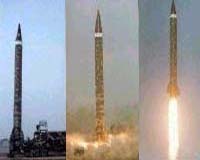
Washington DC (UPI) Feb 4, 2005 Pakistan's lack of strategic depth, could lead South Asia to a nuclear conflict if India and Pakistan go to war, says a report released this week by an organization affiliated with the CIA. The U.S. National Intelligence Council, which reports directly to the Director Central Intelligence, also warns that "the nuclear gap (in the subcontinent) is growing, with Pakistan pulling ahead in terms of nuclear-capable systems." Separated from the British India in 1947, India and Pakistan have already fought three wars during the 57 years. In May 1998, both tested nuclear devices and within a year came close to trying their weapons on each other after a border dispute at Kargil on the Line of Control that runs through the disputed Kashmir region. Since 1998, both India and Pakistan had been beefing up their nuclear arsenals and delivery systems even while engaged in a dialogue aimed at building peace that started in January 2004. International nuclear experts say that India has around 100 warheads while Pakistan possesses half that number. At a seminar in New Delhi last week, both Indian and Pakistani scholars also warned that a nuclear conflict in South Asia was a real possibility and urged both nations to take immediate steps to prevent this possible disaster. Echoing the same concern, the U.S. National Intelligence Council uses the same argument in its warning about nuclear conflict that Pakistan often does for pleading its case for strengthening its conventional arsenal: a strategic imbalance is more likely to lead to a nuclear conflict than any other cause. At a recent paper presented at a Washington think tank, a senior defense official from Pakistan also argued that if Pakistan is ever close to losing a war and feels that its own survival is at stake, it may be forced to use the nuclear option. Unlike the Pakistani military official, the U.S. National Intelligence Council does not endorse Islamabad's demand for more conventional weapons but it does see the possibility of a nuclear conflict in a strategically imbalanced South Asia. "Under plausible scenarios Pakistan might use nuclear weapons to counter success by the larger Indian conventional forces particularly given Pakistan's lack of strategic depth," warns the council. Pakistan is a narrow strip of land stretching from South to Central Asia but it does not have enough width to withstand a major military offensive from India. This lack of strategic depth is the main cause of concern for Pakistan's military planners. Both India and Pakistan appear to understand the likely prices to be paid by triggering a conflict, "but nationalist feelings run high and are not likely to abate," the council observes in a chapter titled "Pervasive insecurity: envisaging possible developments by 2020." Besides, it warns, "Neither understands the other's redlines, and mutual intelligence is poor at best, so escalating dangers are acute. A major terrorist attack in India also could be the catalyst for war." The report, however, points out that even if an armed conflict broke out, it may not automatically lead to a nuclear clash as, "outside powers as well as the primary actors would want to limit its extent." "Advances in modern weaponry - longer ranges, precision delivery, and more destructive conventional munitions - create circumstances encouraging the preemptive use of military force," the report says. The growing dependence of South Asian nations on global financial and trade networks will also act as a deterrent to conflict, the council maintains. The report also warns that the collapse of the current setup in Pakistan is "conceivable and said it's not yet clear what kind of regime would follow" if it happens. Although the report calls Pakistan "the wildcard for the region" because of its "endemic poverty, poor educational system, nuclear weapons, and volatile mix of Muslim movements," it says that it's still possible for Pakistan to come out of this situation along with the rest of the region. "Rising living standards by 2020 leading to greater stability is plausible for Pakistan and the rest of the region, but descent into political upheaval, inter-communal conflict and war between states, including the use of nuclear weapons, is just as possible," the report says. The council warns that Pakistan's "involvement and interest in the proliferation of weapons of mass destruction technology - as a source of export earnings and political power - is unlikely to wane." "Terrorism will be a driver of developments in this region, an accelerator of change. Pakistan could become a victim of terrorism if President Pervez Musharraf and any moderate successors are unable to maintain control over terrorist groups operating in Kashmir." Although the report also warns that a rise in "Hindu chauvinism" was an additional destabilizing force in the region and it is likely to increase. With the third largest Muslim population in the world - 125 million - India thinks of itself as a multi-religious, stable democracy, but the danger of religious conflict is real, the council observes, noting, "This could spill over and aggravate Indo-Pakistani tensions." Discussing India's aspiration to become a world power, the report observes: "India aspires to become a world power, including obtaining a seat on the U.N. Security Council, despite caste problems, an AIDS explosion, and a stagnating burea! ucracy; its resources are unlikely to match its aspirations." All rights reserved. � 2004 Agence France-Presse. Sections of the information displayed on this page (dispatches, photographs, logos) are protected by intellectual property rights owned by Agence France-Presse. As a consequence, you may not copy, reproduce, modify, transmit, publish, display or in any way commercially exploit any of the content of this section without the prior written consent of Agence France-Presse. Related Links SpaceDaily Search SpaceDaily Subscribe To SpaceDaily Express  Rumsfeld Asks For Restoration Of Nuclear 'Bunker Buster' Program
 Washington (AFP) Feb 02, 2005
US Defense Secretary Donald Rumsfeld has asked for restoration of a supersecret research program designed to create a new class of nuclear weapons capable of destroying hardened underground targets, a Pentagon official said late Monday.
|
|
| |||||||||
| The content herein, unless otherwise known to be public domain, are Copyright 1995-2016 - Space Media Network. All websites are published in Australia and are solely subject to Australian law and governed by Fair Use principals for news reporting and research purposes. AFP, UPI and IANS news wire stories are copyright Agence France-Presse, United Press International and Indo-Asia News Service. ESA news reports are copyright European Space Agency. All NASA sourced material is public domain. Additional copyrights may apply in whole or part to other bona fide parties. Advertising does not imply endorsement, agreement or approval of any opinions, statements or information provided by Space Media Network on any Web page published or hosted by Space Media Network. Privacy Statement All images and articles appearing on Space Media Network have been edited or digitally altered in some way. Any requests to remove copyright material will be acted upon in a timely and appropriate manner. Any attempt to extort money from Space Media Network will be ignored and reported to Australian Law Enforcement Agencies as a potential case of financial fraud involving the use of a telephonic carriage device or postal service. |