|
 |
 |
 |
 |
 |
 |
 |
 |
 |

| . |  |
. |
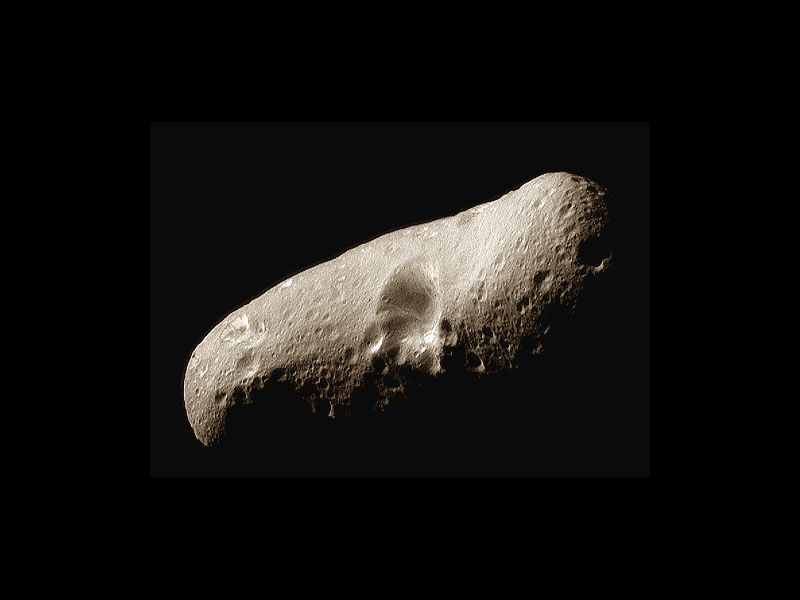
Greenbelt - March 13, 2000 - Like a shy bride peeking from beneath her veil, the asteroid Eros gave researchers using the NEAR spacecraft the first glimpse of its true nature after massive solar flares briefly lit its surface. The elements magnesium, aluminum, silicon, and iron were observed. These are important elements in studying the formation of solar system bodies. Two powerful explosions on the Sun, called solar flares, blasted the surface of Eros with X-rays on March 2. Each 300-second blast caused elements at Eros' surface to glow in unique X-ray "colors," depending on the element's classification. The X-ray/Gamma-ray Spectrometer (XGRS) instrument on NEAR analyzed this X-ray glow and identified the various elements present. "This is the first time anyone has used an X-ray signature to identify the composition of an asteroid, and it's very exciting," said Dr. Jacob Trombka, XGRS Science Team Leader at NASA's Goddard Space Flight Center, Greenbelt, Md. "The interpretation of these types of X-ray signatures will help us determine whether this asteroid can be associated with any of the known classes of meteorites and further our knowledge of the origin of Eros. We only saw a small area of Eros from an extreme angle, and, at more than 180 miles, NEAR is still far from Eros. This first observation indicates that when we get closer, our data will improve." The ability to record and analyze the X-ray glow at such a distance gives the XGRS team confidence that their mission, scheduled to begin in May when NEAR is only 31 miles from Eros, will be successful. "Eros is a Rosetta stone that can return us to our cosmological roots by determining what happened during the solar system's formation, and the XGRS is a key to translating its language - that of geochemistry," said Dr. Pamela Clark of Goddard. When a forming planet reaches a certain size, its heat and gravity become sufficient to cause differentiation of its elements - the planet becomes molten and heavy elements, like nickel and iron, tend to sink to the center while light elements, like silicon and carbon, rise to the surface. If Eros is composed mostly of light elements, this indicates that it is a fragment from near the surface of a larger body. If it is rich in heavy elements, it is likely from the center of a larger object. If instead it is undifferentiated, like the chondrite meteorites found on Earth, it probably never was exposed to much heat. This implies that it is a very primitive, unprocessed object, probably an aggregate of smaller objects from the early solar system nebula. "The last successful observation of characteristic X-ray emissions from a solar system body, the moon, was carried out by our Goddard group during the Apollo 15 and 16 missions over twenty five years ago," said Trombka.
NEAR NEWS
Eros Desktops:
1 -
2 -
3 -
4 -
5 -
6
|
|
| |||||||||
| The content herein, unless otherwise known to be public domain, are Copyright 1995-2016 - Space Media Network. All websites are published in Australia and are solely subject to Australian law and governed by Fair Use principals for news reporting and research purposes. AFP, UPI and IANS news wire stories are copyright Agence France-Presse, United Press International and Indo-Asia News Service. ESA news reports are copyright European Space Agency. All NASA sourced material is public domain. Additional copyrights may apply in whole or part to other bona fide parties. Advertising does not imply endorsement, agreement or approval of any opinions, statements or information provided by Space Media Network on any Web page published or hosted by Space Media Network. Privacy Statement All images and articles appearing on Space Media Network have been edited or digitally altered in some way. Any requests to remove copyright material will be acted upon in a timely and appropriate manner. Any attempt to extort money from Space Media Network will be ignored and reported to Australian Law Enforcement Agencies as a potential case of financial fraud involving the use of a telephonic carriage device or postal service. |