|
 |
 |
 |
 |
 |
 |
 |
 |
 |

| . |  |
. |
NJIT Chemists Modify Carbon Nanotubes Using Microwaves
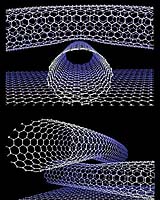
Researchers at New Jersey Institute of Technology have discovered a novel method of changing the chemical characteristics of carbon nanotubes by heating them in a closed vessel microwave oven. Somenath Mitra, PhD, professor of chemistry and environmental sciences, and Zafar Iqbal, PhD, also a professor of chemistry and environmental sciences, recently discussed their findings at the 229th national meeting of the American Chemical Society at the Hyatt Regency Hotel, San Diego. The pair, aided by doctoral student Yubing Wang, have written "Microwave-Induced, Green and Rapid Chemical Functionalization of Single-Walled Carbon Nanotubes" to be published in a forthcoming issue of the journal Carbon. Carbon nanotubes, which were only discovered in 1991, are molecular-scale nano materials made from carbon atoms connected single-file in a tube. The tubes are closed at either end by hemispherical structures and typically exhibit lengths ranging from tens of micrometers to a few millimeters. "We understand ourselves to be the first in the world to have discovered this method," said Mitra. "The beauty is that our method is green and clean. We use no toxic material and reduce the reaction times from hours - on occasion even days - to three minutes." Iqbal noted that the method costs much less than others currently used. "Plus, the solubility of our carbon nanotubes are several times higher than any other researcher has yet reported in this short amount of time." Solubility is the most essential characteristic of carbon nanotubes since researchers must be able to dissolve them to see them work their magic. With a microwave oven hitting temperatures of 250 degrees Celsius, the researchers can chemically modify the tubes. Such a temperature is closer to radiation treatment than the output of a kitchen microwave oven. Since the reactions are fast, the nanotubes are not damaged or structurally modified. "A carbon nanotube is just carbon," said Mitra. "The surprise for us is that it's difficult to make nanotubes react with anything. They are like diamonds -very, very inert. They don't react and they don't dissolve in water. "But, if you can change their chemical characteristics as we have done using our method, we see them transform right before our eyes." Once the tiny, microscopic tubes are chemically altered, they become soluble in common solvents like water and alcohol, and new kinds of films or coatings can be produced. The tubes can also be formulated into paints and plastic nanocomposites. The functionalized nanotubes become more useful than the pristine ones because the functionalized groups can be tailored for specific applications. "Nanotubes are opening new vistas for products and design," added Mitra. "For example, the space shuttle includes components of lightweight carbon or carbon-polymer composites. The military especially likes these materials because ultimately they will allow for the development of lightweight equipment." Related Links New Jersey Institute of Technology SpaceDaily Search SpaceDaily Subscribe To SpaceDaily Express  Water, Water Everywhere Nano
 New York (UPI) Mar 18, 2005
One of the single biggest applications of nanotechnology could be solving the global shortage of pure water, experts told UPI's Nano World.
|
|
| |||||||||
| The content herein, unless otherwise known to be public domain, are Copyright 1995-2016 - Space Media Network. All websites are published in Australia and are solely subject to Australian law and governed by Fair Use principals for news reporting and research purposes. AFP, UPI and IANS news wire stories are copyright Agence France-Presse, United Press International and Indo-Asia News Service. ESA news reports are copyright European Space Agency. All NASA sourced material is public domain. Additional copyrights may apply in whole or part to other bona fide parties. Advertising does not imply endorsement, agreement or approval of any opinions, statements or information provided by Space Media Network on any Web page published or hosted by Space Media Network. Privacy Statement All images and articles appearing on Space Media Network have been edited or digitally altered in some way. Any requests to remove copyright material will be acted upon in a timely and appropriate manner. Any attempt to extort money from Space Media Network will be ignored and reported to Australian Law Enforcement Agencies as a potential case of financial fraud involving the use of a telephonic carriage device or postal service. |