|
 |
 |
 |
 |
 |
 |
 |
 |
 |

| . |  |
. |
Boeing MDR Payload Makes Milstar 2 Birds Jam-Resistant
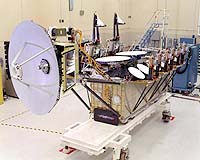
A U.S. Air Force Milstar 2 satellite equipped with a powerful medium-data-rate (MDR) communications payload supplied by Boeing Satellite Systems Inc. (BSS), will launch on Feb. 24 from Cape Canaveral Air Station, Fla. The four-hour launch window opens at 11:09 a.m. PST (2:09 p.m. EST and 7:09 p.m. GMT). The MDR payload provides secure, jam-resistant communications to U.S. forces through unique onboard signal- and data-processing capabilities. The satellite's crosslink payload is also supplied by BSS, a unit of The Boeing Company located in El Segundo, Calif. "BSS is proud to have been part of the Milstar satellite team since 1982," stated Tig H. Krekel, president of Boeing Satellite Systems. "After a successful launch, this satellite will be the first with the new MDR communications hardware. This technology will meet the needs of multiple users by supporting the connectivity of tactical and conventional forces." Designated as F-4, the satellite being orbited in February is the fourth in a series of six Milstar 2 spacecraft to be built by a team headed by prime contractor Lockheed Martin Space Systems of Sunnyvale, Calif. BSS delivered the MDR and crosslink payload hardware to Lockheed Martin Space Systems in June 1998. The first BSS-supplied MDR payload was aboard the F-3 spacecraft, which was left in a useless orbit after a launch vehicle failure. The MDR payload dynamically sorts incoming data and routes them to the proper downlinks to establish networks and provide bandwidth on demand. Using a 32-channel extremely high-frequency (44 GHz) uplink and a super-high-frequency (20 GHz) downlink, it sends real-time voice, video and data to military personnel in the field at rates that range from 4.8 Kbps to 1.5 Mbps. That is up to 50 times faster than a common PC modem. The crosslinks provide communications capability at 60 GHz between Milstar satellites for both the MDR payload and the 2.4 Kbps low data rate (LDR) communications payload on the satellites. As the supplier of the MDR payload, BSS integrates antennas and electronic units onto the MDR structure, called the -X (minus X) wing, provided by Lockheed Martin. Together the MDR payload weighs about 1,100 pounds and uses 860 watts of power. The MDR antenna coverage subsystem consists of eight narrow spot beam antennas provided by TRW: two narrow spot beams with nulling capabilities (nuller antennas) and six distributed user coverage antennas (DUCAs), each supporting two-way communications. In contrast to commercial communications satellites, whose beams can cover entire continents, Milstar's beams are very narrow, providing less opportunity for enemy detection and penetration. The nuller antennas resist jamming from within their respective coverage areas by changing their gain patterns when a jamming signal is detected. The DUCAs provide high gain/low sidelobes for distributed users. Beyond Milstar, Boeing Satellite Systems joined with Lockheed Martin and TRW in May 2000 to form the Advanced Extremely High Frequency (Advanced EHF) National Team to build the follow-on to the DoD's Milstar highly secure communication satellite program. Formation of the new team will accelerate the deployment of the new system to help bridge the gap in military communications capabilities caused by the loss of the third Milstar satellite. Under the National Team arrangement, Boeing will lead the payload effort and will be responsible for payload integration, as well as production of radio frequency electronics and phased array antennas for the five satellite Advanced EHF systems. Related Links Milstar Flight 4 Launch Team SpaceDaily Search SpaceDaily Subscribe To SpaceDaily Express  LockMart To Launch New Milstar
 Cape Canaveral - Feb. 19, 2001 Cape Canaveral - Feb. 19, 2001A US Air Force Milstar II military communications satellite is ready for liftoff from Cape Canaveral Air Station, Fla., on Friday, Feb. 24, aboard a Titan IV launch vehicle. The satellite and launch vehicle were built by Lockheed Martin at its operations in Sunnyvale and Denver.
|
|
| |||||||||
| The content herein, unless otherwise known to be public domain, are Copyright 1995-2016 - Space Media Network. All websites are published in Australia and are solely subject to Australian law and governed by Fair Use principals for news reporting and research purposes. AFP, UPI and IANS news wire stories are copyright Agence France-Presse, United Press International and Indo-Asia News Service. ESA news reports are copyright European Space Agency. All NASA sourced material is public domain. Additional copyrights may apply in whole or part to other bona fide parties. Advertising does not imply endorsement, agreement or approval of any opinions, statements or information provided by Space Media Network on any Web page published or hosted by Space Media Network. Privacy Statement All images and articles appearing on Space Media Network have been edited or digitally altered in some way. Any requests to remove copyright material will be acted upon in a timely and appropriate manner. Any attempt to extort money from Space Media Network will be ignored and reported to Australian Law Enforcement Agencies as a potential case of financial fraud involving the use of a telephonic carriage device or postal service. |