|
 |
 |
 |
 |
 |
 |
 |
 |
 |

| . |  |
. |
New Space Aggressor Squadron Activated At Peterson
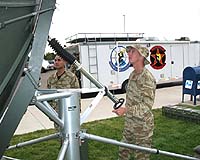
for Air Force News Service Peterson AFB - Nov 18, 2003 The 26th Space Aggressor Squadron, an Air Force reserve unit, was activated during a ceremony here at Air Force Space Command headquarters, Oct. 3. The squadron was formerly a space aggressor flight under the 14th Test Squadron, 310th Space Group at Schriever Air Force Base, Colo. Lt. Col. Guy Morley Jr., former space aggressor flight commander leads the new squadron. "It's a great honor to command the oldest squadron of the Air Force Reserve," said Morley. "I'm extremely fortunate to have the opportunity to create this unit and mission from scratch for the Reserve -- the first aggressor squadron in the command's history." "It's with great pride that I welcome the 26th Space Aggressors into the 310th family of professionals. Their innovative approach as an adversary directly translates into securing space superiority for our nation," said Col. Roscoe Griffin, 310th Space Group commander. Although the 26th SAS has a new name, their mission remains unchanged. "We provide a thorough understanding of what a threat force could do to jeopardize the success of joint missions utilizing space assets," said Morley. Threat replication is the verbiage that space aggressors use to define their mission. The information gathered by the space aggressors is used to realistically train forces to potential threats. This enhances the military's capability to counter threats whether from an opposing military or a single terrorist. Satellite systems are of vital importance to the military. According to the commander, if the enemy found a way to limit their use, it could severely hamper operations in the field. "We assist troops in developing the means to work around such degradation in order to operate unhampered by the effects of a threat," he said. An aggressor squadron is vitally important in identifying threats and then finding a solution to them, he said. They train forces in countering these threats. This training proved its worth during Operation Iraqi Freedom. For the first time, an enemy deployed jammers against the Global Positioning System. Through the training U.S. forces received from the space aggressors, effective countermeasures were used and the jamming of the GPS was ineffective, according to Morley. During the ceremony Maj. Robert Rysavy, 26th SAS plans flight commander, described how a large measure of the squadron's success against potential jammers is the result of the space aggressors' efforts in finding threats and then neutralizing them. One instance was described where two young lieutenants were tasked to make a communications jamming device for less than $10,000 and they managed to build one for only $7,500 by using equipment purchased at a hardware store. This shows how easy and inexpensive it is for a potential terrorist to build something that is a threat to U.S. forces. "The events associated with the activation of the 26th Space Aggressor Squadron and [Morley's] assumption of command were the most impressive that I have ever experienced -- professional in every respect," said retired Lt. Gen. Jack Murphy, former 26th Aggressor Squadron commander. The change from flight to a squadron increases their size from 10 to 35 positions. Eight of the positions are active Guard and Reserve positions, while the other 27 are traditional Reserve slots. The 26th SAS has a long and proud history dating back to 1915 as the 1st Aero Company. The unit was re-designated the 26th Aero Squadron in 1917, and then in 1921 to the 26th Attack Squadron. The squadron was located in Hawaii December 7, 1941, and lost 70 percent of its personnel during the attack on Pearl Harbor. The squadron served with distinction during World War II. During Vietnam, air-to-air kill ratios dropped to nearly one to one. To change this an aggressor squadron was needed to train pilots in air combat. The 26th Attack Squadron was then re-designated as the 26th Aggressor Squadron. In 1990, the Air Force terminated the aggressor program and the 26th was disbanded. During the 1990's developing technologies provided new threats to the United States. On October 2000, two new aggressor squadrons were formed; the 527th and a reserve flight under the 14th Test Squadron, which has now been expanded to the 26th SAS. Related Links Air Force Space Command SpaceDaily Search SpaceDaily Subscribe To SpaceDaily Express  The Military Space Service: Why It's Time Has Come
 Washington - Nov 17, 2003
The future of U.S. supremacy in space is in jeopardy, writes Franz J. Gayl. New entrants to space exploration, rich in both intellectual capital and superpower ambitions, are pressing irresistibly forward. These include formidable past competitors, such as China and Russia, as well as India, Japan, Europe, and others.
|
|
| |||||||||
| The content herein, unless otherwise known to be public domain, are Copyright 1995-2016 - Space Media Network. All websites are published in Australia and are solely subject to Australian law and governed by Fair Use principals for news reporting and research purposes. AFP, UPI and IANS news wire stories are copyright Agence France-Presse, United Press International and Indo-Asia News Service. ESA news reports are copyright European Space Agency. All NASA sourced material is public domain. Additional copyrights may apply in whole or part to other bona fide parties. Advertising does not imply endorsement, agreement or approval of any opinions, statements or information provided by Space Media Network on any Web page published or hosted by Space Media Network. Privacy Statement All images and articles appearing on Space Media Network have been edited or digitally altered in some way. Any requests to remove copyright material will be acted upon in a timely and appropriate manner. Any attempt to extort money from Space Media Network will be ignored and reported to Australian Law Enforcement Agencies as a potential case of financial fraud involving the use of a telephonic carriage device or postal service. |