|
 |
 |
 |
 |
 |
 |
 |
 |
 |

| . |  |
. |
Digitally Directed, The Mars Missions
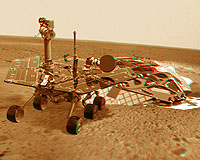
for Astrobiology Magazine Moffett Field - Feb 11, 2004 In the first of a two-part series, the film-maker for the Mars Exploration Rovers (MER) video, Daniel Maas, talks to Astrobilology Magazine about how the stunningly realistic mission simulation came to life. In this part, he describes the inner workings of how such realism is obtained. His eight-minute video required over 12,000 frames playing at 24 frames per second for its film quality. From research to compositing and rendering, his art took three to four years to complete. In the subsequent part Maas answers questions about how he learned his techniques of Hollywood animation for rendering the red planet and its rovers. I begin the production process by collecting photos, diagrams, and blueprints of the hardware and environments to be depicted. These references guide me as I build digital models of the robotic probes and their surroundings. By constantly comparing my results to real-world images, I ensure that my designs are accurate and realistic. Using a CAD system, I assemble primitive 3D shapes (planes, boxes, spheres, and cylinders) into three-dimensional replicas of the probes and their instruments. During this process, which typically takes two to three weeks, I also assign material types to the surfaces of the model: metal surfaces which later take on a metallic look, plastic surfaces will appear plastic, and so on. When modelling is complete, I assemble the separately-created chassis, instruments, solar panels, and antennae into a complete digital space probe, designating their relative positions and axes of motion. I also insert "handles" to control each major moving part, much like rods on a puppet. Using these I can quickly and easily manipulate the model into my desired position. For each scene of the video, I position the digital models and simulated camera within the 3D environment, just like a director arranges a film set. To create motion, I indicate where the models should appear at various key moments; the animation software then interpolates their positions throughout the whole shots. At this stage I work with a low-quality preview of the first image. These rough renderings give a good sense of the composition and timing, and can be generated quickly enough for interactive use. After the final animation sequences are approved, it's time to generate high-quality renderings of the digital models and environments. To achieve a realistic appearance, I coat the 3D surfaces with detailed painted images or photos. The rendering software automatically adds shadow and reflections using ray-tracing. These computations are quite time-consuming; a single frame can take minutes or even hours to generate. The entire Mars Rover animation was rendered on a network of 8 Pcs. Each frame took anywhere from one minute to two hours to compute (there are 24 frames per second of footage). I often decide to render a scene in several different layers or passes -- like a single frame consisting of three separately rendered elements. Each layer is color-corrected, blurred, and moved individually, then combined into the final frame. This technique also saves time if one element needs to be re-rendered, since the other layers do not need to be generated again. Finally, to add an authentic touch to the computer-generated images, I simulate several defects of real-world cameras, such as film grain (random noise) and soft glows around bright highlights. These deliberate degradations help to remove the unrealistically sterile appearance of raw computer renderings. Related Links Mars Rovers at JPL Mars Rovers at Cornell SpaceDaily Search SpaceDaily Subscribe To SpaceDaily Express  Opportunity Sees Tiny Spheres in Martian Soil
 Pasadena (JPL) Feb 09, 2004
NASA's Opportunity has examined its first patch of soil in the small crater where the rover landed on Mars and found strikingly spherical pebbles among the mix of particles there. "There are features in this soil unlike anything ever seen on Mars before," said Dr. Steve Squyres of Cornell University, Ithaca, N.Y., principal investigator for the science instruments on the two Mars Exploration Rovers.
|
|
| |||||||||
| The content herein, unless otherwise known to be public domain, are Copyright 1995-2016 - Space Media Network. All websites are published in Australia and are solely subject to Australian law and governed by Fair Use principals for news reporting and research purposes. AFP, UPI and IANS news wire stories are copyright Agence France-Presse, United Press International and Indo-Asia News Service. ESA news reports are copyright European Space Agency. All NASA sourced material is public domain. Additional copyrights may apply in whole or part to other bona fide parties. Advertising does not imply endorsement, agreement or approval of any opinions, statements or information provided by Space Media Network on any Web page published or hosted by Space Media Network. Privacy Statement All images and articles appearing on Space Media Network have been edited or digitally altered in some way. Any requests to remove copyright material will be acted upon in a timely and appropriate manner. Any attempt to extort money from Space Media Network will be ignored and reported to Australian Law Enforcement Agencies as a potential case of financial fraud involving the use of a telephonic carriage device or postal service. |