|
 |
 |
 |
 |
 |
 |
 |
 |
 |

| . |  |
. |
The Sky Is The Limit
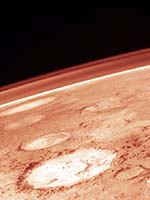
Believe it or not, some of the scientists on the Mars Exploration Rover Science team don't really care too much about rocks - or for that matter anything on the surface of Mars. They have "higher" ambitions. Their passion lies in the skies - the martian skies - and, from the hazy glow of the atmosphere, they pull precious pieces of information. Two of these sky gazers are Mike Wolff and Mike Smith. They are brimming with energy because, in the next few sols, Spirit will be doing more atmospheric study than she's done since landing. "It's a bit of a running joke that the atmospheric team gets left out," laughs the jovial pair. "Let's be honest, this is predominantly a geology mission - water and rocks." The atmospheric team is also a little outnumbered, "There are very few of us atmospheric scientists who want to spend Spirit's time looking at the sky. The vast majority of the team wants to look at the ground." All the joking aside, Mike and Mike know the importance of good atmospheric data, explaining that it is crucial for "ground-lookers" to know what they are seeing. For instance, scientists study the light that is reflected from each surface to determine what minerals are in the rocks on Mars. In order to make accurate calculations, they must understand the atmosphere through which the light traveled before reaching the rocks and reflecting back. "They DO need us," smiles Wolff. "Our team provides information about the amount of dust and water vapor in the atmosphere, allowing other teams to make sense of what they're seeing." Beyond a supportive role, the atmospheric team is trying to answer big questions about the climate on Mars that will help all future Mars exploration. "We need a complete understanding of the environment we're working with - what conditions do we need to prep for? How much dust is there, and will it interfere with machinery? What are the temperature extremes that can interfere with the successful operation of instruments? The more we understand the weather on Mars, the more likely it is that a Mars mission will have success," explains Smith in a serious moment. The term "weather on Mars" can mean a lot of different things, but the atmospheric team is harvesting hypotheses from four main elements: air temperature, water-ice clouds, water vapor, and dust.
Air Temperature "All the major weather systems on Mars are affected by this lower area, so it's really fantastic to be seeing this detailed data," says Smith. These temperature readings assist engineers as they assess the rovers' heath. Engineers need to know if things are heating up on Mars so that they can prepare to keep the rover cool.
Water Vapor
Water-Ice Clouds While orbiters have provided us with many great images of cloud-cover on Mars, they are limited by the time of day of their orbit and can only reveal what the clouds look like in a particular spot at a particular time. "With Spirit and Opportunity we can watch the clouds throughout the day and monitor how they change," explains Wolff.
Dust During the mission, Spirit will point its Panoramic camera and Mini-TES instruments towards the sky, giving the atmospheric team another chance to shine. Most of the atmospheric sequences only take under 20 minutes, and are easy to fit into all the rover's other daily activities. "We'll hopefully have lots of these "fill-in" sequences throughout the mission," explains a smiling Smith. "We don't ask for much, but we promise to deliver a lot!" Related Links Mars Rovers at JPL Mars Rovers at Cornell SpaceDaily Search SpaceDaily Subscribe To SpaceDaily Express  Martian Science Season Gets Off To A Rocky Start
 Pasadena - Jan 20, 2004
NASA's Spirit rover has successfully driven to its first target on Mars, a football-sized rock that scientists have dubbed Adirondack. The Mars Exploration Rover flight team at NASA's Jet Propulsion Laboratory, Pasadena, Calif., plans to send commands to Spirit early Tuesday to examine Adirondack with a microscope and two instruments that reveal the composition of rocks, said JPL's Dr. Mark Adler, Spirit mission manager. The instruments are the M�ssbauer spectrometer and the alpha particle X-ray spectrometer.
|
|
| |||||||||
| The content herein, unless otherwise known to be public domain, are Copyright 1995-2016 - Space Media Network. All websites are published in Australia and are solely subject to Australian law and governed by Fair Use principals for news reporting and research purposes. AFP, UPI and IANS news wire stories are copyright Agence France-Presse, United Press International and Indo-Asia News Service. ESA news reports are copyright European Space Agency. All NASA sourced material is public domain. Additional copyrights may apply in whole or part to other bona fide parties. Advertising does not imply endorsement, agreement or approval of any opinions, statements or information provided by Space Media Network on any Web page published or hosted by Space Media Network. Privacy Statement All images and articles appearing on Space Media Network have been edited or digitally altered in some way. Any requests to remove copyright material will be acted upon in a timely and appropriate manner. Any attempt to extort money from Space Media Network will be ignored and reported to Australian Law Enforcement Agencies as a potential case of financial fraud involving the use of a telephonic carriage device or postal service. |