|
 |
 |
 |
 |
 |
 |
 |
 |
 |

| . |  |
. |
Scientists Don't Judge A Book By First Day Cover
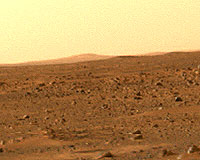
"Scientists have a crush on Mars, and it's hard not to look only for things we want to see," says Mars Exploration Rover scientist, John Grant, from Washington D.C.'s National Air and Space Museum. For two years, scientists have wanted to come to Gusev Crater because pictures and data taken from the Mars Odyssey and Mars Global Surveyor orbiters have shown evidence that a river may have once flowed into the crater. Now that Spirit has safely landed in Gusev Crater, scientists must interpret the right clues that will lead them to understand the geologic processes that formed the area. "We've talked about Gusev Crater being a dry lake bed for so long, there's a danger of getting trapped into believing only in that possibility," warned Grant. Scientists are forcing themselves to be patient as they begin gathering clues to figure out how this site formed for sure. "To be trite, you can't judge a book by its cover," explains Jeff Moersch, participating scientist from University of Tennessee. There can be multiple explanations for the same geologic observation. "For example, take a look at these two pictures on Earth, which look very similar to Spirit's landing site on Mars. Look at the shapes of rocks in the pictures, the size of rocks, the number of rocks in a certain area or the 'rock distribution' as we geologists say," said Moersch. At first glance, these two places on Earth look similar, and one could assume the same geologic processes formed the landscapes. However, geologists have gone to these two places on Earth and discovered they were formed in different ways. The Haughton Impact Structure is a crater in the Canadian Arctic and is roughly 23-million years old. The bottom of the crater flooded and a lake formed inside the crater. Some of the rocks are scratched in a way that tell geologists that glaciers probably transported the rocks into the crater later. At a glance, the landscape in the Saf Saf area in Egypt looks similar to the Haughton Impact Structure. The Saf Saf landscape, however, doesn't have anything to do with an ancient lake. Although one's eyes are drawn to the flat area, similar rock angles, the rock distribution, the light soil, and further subtle clues observed by geologists revealed that no water ever flowed where the rocks are scattered in Saf Saf. A river only flowed behind the rocks in the smoother area up above the rocks. Without Other Instruments on the Rovers, Scientists Could Argue for Decades About Gusev's History "When I first saw the pictures from Mars, I caught myself saying, 'I know this place,' because it looked like places I had seen on Earth," said Grant. "But, we're being very cautious right now because we know we have never seen this place before, and we must wait for the other instruments such as the Microscopic Imager and M�ssbauer Spectrometer to reveal better clues about this landscape," explained Grant. "If we only had pictures of the landing site, we scientists would argue for decades and maybe never know for sure how this place formed," said Grant. "This is like a book that is being read," explained Moersch, and the science team is working hard not to judge this martian book by its cover. "Like good detectives, we are looking at everything we can and gathering as many clues as possible to see if water ever was in this crater long enough to provide an oasis for life," said Moersch. Related Links Mars at JPL MERs at Cornell SpaceDaily Search SpaceDaily Subscribe To SpaceDaily Express  AFRL Computer Guides NASA Rovers to Mars
 Kirtland AFB - Jan 12, 2004
Radiation-resistant computers developed here by the Air Force Research Laboratory (AFRL) helped not only steer one of NASA's Mars Exploration Rovers to the red planet last week, they also guided it to a safe and spectacular landing on Mar's rocky surface. Another landing is scheduled for later in the month.
|
|
| |||||||||
| The content herein, unless otherwise known to be public domain, are Copyright 1995-2016 - Space Media Network. All websites are published in Australia and are solely subject to Australian law and governed by Fair Use principals for news reporting and research purposes. AFP, UPI and IANS news wire stories are copyright Agence France-Presse, United Press International and Indo-Asia News Service. ESA news reports are copyright European Space Agency. All NASA sourced material is public domain. Additional copyrights may apply in whole or part to other bona fide parties. Advertising does not imply endorsement, agreement or approval of any opinions, statements or information provided by Space Media Network on any Web page published or hosted by Space Media Network. Privacy Statement All images and articles appearing on Space Media Network have been edited or digitally altered in some way. Any requests to remove copyright material will be acted upon in a timely and appropriate manner. Any attempt to extort money from Space Media Network will be ignored and reported to Australian Law Enforcement Agencies as a potential case of financial fraud involving the use of a telephonic carriage device or postal service. |