
 |
 |
 |
 |
 |
 |
 |
 |
 |
 |

| . |  |
. |
ISS Faces 10% Chance Of Disaster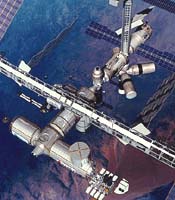 Paris (AFP) December 24, 1999 - The International Space Station (ISS) faces a risk of up to 10 percent of disaster over the next 15 years, mainly because of the danger of a collision with tiny meteorites, a report says.
Washington-based management consultancy, Futron, calculates that the loss of the ISS in any eight-month period lies between one in 200 and one in 500. Futron presented its risk assessment in a report to the US National Aeronautical and Space Administration (NASA). This means "there's a five- to 10-percent chance of disaster over 15 years," the British weekly New Scientist reports in its December 25 issue. "Its calculations suggest that, if this happens, there is a 93-percent probability that a micrometeorite impact will be the cause," the article said. Only two percent of the risk would come from fires, explosions or collisions between spacecraft, according to Futron's calculations. The consultancy added that the ISS' controllers could expect at least one "loss of a crewmember" over the next 15 years -- a category that includes death as well as illness or an accident requiring evacuation of an astronaut. Futron admits its analysis is preliminary, and based on the calculation of risk faced by a station crewed by three astronauts, halfway through construction. These figures were then extended to cover a 15-year period. But experts already contest Futron's approach, not least because it suggests that accidents inside the station will be a greater risk to the astronauts than space walks, New Scientist said. This is surprising, given that astronauts will have to carry out an unprecedented amount of space-walking to put the ISS together. They also query the assumption about micrometeorites, noting that the now defunct Soviet/Russian space station Mir had little problem with collisions with material from space, but was several times imperilled by fires or computer crashes. Micrometeorites are tiny particles, often no bigger than a speck of dust, that are part of the cosmic debris hurtling through space. The huge speed at which they travel could cause them to damage equipment or even perforate the ISS' hull. The ISS, a partnership of 16 countries, is being assembled from modules under a 40-flight schedule over the next five years. Since November 1998, two modules have already been connected -- the Russian-built Zarya and the US-built Unity -- and a US shuttle mission in June this year supplied them with tools and cranes. When completed, the ISS will have an internal volume roughly equivalent to that of the cabin of a 747 jumbo jet. It will be inhabited by an international crew of up to seven, living and working in space for between three and six months at a time.
TECH SPACE
|
|
| ||||||||
| The content herein, unless otherwise known to be public domain, are Copyright 1995-2016 - Space Media Network. All websites are published in Australia and are solely subject to Australian law and governed by Fair Use principals for news reporting and research purposes. AFP, UPI and IANS news wire stories are copyright Agence France-Presse, United Press International and Indo-Asia News Service. ESA news reports are copyright European Space Agency. All NASA sourced material is public domain. Additional copyrights may apply in whole or part to other bona fide parties. Advertising does not imply endorsement, agreement or approval of any opinions, statements or information provided by Space Media Network on any Web page published or hosted by Space Media Network. Privacy Statement All images and articles appearing on Space Media Network have been edited or digitally altered in some way. Any requests to remove copyright material will be acted upon in a timely and appropriate manner. Any attempt to extort money from Space Media Network will be ignored and reported to Australian Law Enforcement Agencies as a potential case of financial fraud involving the use of a telephonic carriage device or postal service. |
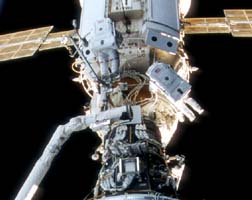 Washington - December 9, 1999 - As U.S. astronauts and Russian cosmonauts build the International Space Station, NASA should consider taking further measures to limit their exposure to radiation that sporadically occurs around the station, says a new report from a committee of the National Academies' National Research Council.