|
 |
 |
 |
 |
 |
 |
 |
 |
 |

| . |  |
. |
Spacewalkers To Outfit Station's Exterior
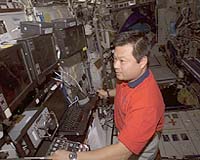
The Expedition 10 crew is getting set to venture outside the International Space Station for the first of the mission's two spacewalks. Commander Leroy Chiao and Flight Engineer Salizhan Sharipov will install a work platform, mount a robotics experiment, check vents on systems that help control the Station's atmosphere and install a scientific experiment in the early morning hours of Jan. 26. The spacewalk is to begin about 2:30 a.m. EST and should last almost 5.5 hours. Most of the work will be done outside the Zvezda Service Module. Spacewalkers will use the airlock of the Russian Pirs docking compartment and wear Russian Orlan spacesuits. Both spacewalkers will wear suits with red stripes. They will be distinguishable by the U.S. flag on Chiao's shoulder. This will be Chaio's fifth spacewalk and Sharipov's first. After opening the hatch and assembling equipment, Sharipov and Chiao will move from the Pirs back to about the middle of the Zvezda. There they will begin what should be about a two-hour job, installation of a Universal Work Platform � a kind of space work table � and its base, along with associated wiring. Next they'll install on the work platform the European commercial experiment Rokviss (Robotic Components Verification on ISS). That experiment explores the use of manipulator rotary joints, operated from inside Zvezda via a receiver-transmitter. Rokviss is designed to study remote operation of such joints and the effects of space on them. The German device could help lead to a new generation of space robots. Sharipov and Chiao will work together to relocate the Japanese MPAC&SEED (Microparticle and Capture & Space Environment Exposure Device) experiment to a new location on its rail-like mounting. That experiment exposes various materials to space. At the old MPAC&SEED location they will install a Rokviss antenna, then run and connect cables to link a transceiver with the experiment and the antenna. Still outside Zvezda, they will inspect and photograph gas vent nozzle extenders including those of the Elektron and Vozdukh. Both the Elektron, which divides water into its components, oxygen for the Station's interior and hydrogen, which is vented overboard, and Vozdukh, a carbon-dioxide scrubber, have experienced some glitches recently. The inspection should help determine if the vents could be part of the problem. The spacewalk was lengthened by a little over an hour so this task could be done. Once it is finished, Sharipov and Chiao will move with their tool carrier back to Pirs. Finally, on the outside of the Docking Compartment, they will install the Russian Biorisk experiment. It looks at the impact of spaceflight on microorganisms. Eventually information from the experiment could be used to keep us from contaminating other planets with Earth's microorganisms, or perhaps even to protect our own planet. The spacewalkers are scheduled to re-enter the airlock and close the hatch at about 8 a.m. EST. This will be the 57th spacewalk to assemble and maintain the Station. It will be the 32nd spacewalk from the Station itself, and the 14th from Pirs. A second spacewalk for Chiao and Sharipov is scheduled for March. During that spacewalk, they will install navigational and communications equipment for the arrival of the first Automated Transfer Vehicle cargo craft. The ATV is an unpiloted cargo carrier similar in some ways to the Russian Progress spacecraft, but it has more than double the cargo capacity of the Progress. It is scheduled to make its first flight late this year. Related Links ISS at NASA SpaceDaily Search SpaceDaily Subscribe To SpaceDaily Express  Space Watch: Cooperation's Failure At ISS
 Washington DC (UPI) Jan 20, 2005
The recent Russian decision to cease transporting U.S. astronauts to the International Space Station after 2005 highlights two harsh realities few Americans have been willing to face: the Clinton administration did not plan well in building the ISS and the new Bush space exploration initiative has compounded the problem.
|
|
| |||||||||
| The content herein, unless otherwise known to be public domain, are Copyright 1995-2016 - Space Media Network. All websites are published in Australia and are solely subject to Australian law and governed by Fair Use principals for news reporting and research purposes. AFP, UPI and IANS news wire stories are copyright Agence France-Presse, United Press International and Indo-Asia News Service. ESA news reports are copyright European Space Agency. All NASA sourced material is public domain. Additional copyrights may apply in whole or part to other bona fide parties. Advertising does not imply endorsement, agreement or approval of any opinions, statements or information provided by Space Media Network on any Web page published or hosted by Space Media Network. Privacy Statement All images and articles appearing on Space Media Network have been edited or digitally altered in some way. Any requests to remove copyright material will be acted upon in a timely and appropriate manner. Any attempt to extort money from Space Media Network will be ignored and reported to Australian Law Enforcement Agencies as a potential case of financial fraud involving the use of a telephonic carriage device or postal service. |