|
 |
 |
 |
 |
 |
 |
 |
 |
 |

| . |  |
. |
First Inmarsat-4 Satellite Ready For Launch Thursday
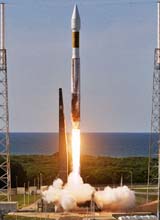
The world's largest and most sophisticated commercial communications satellite, Inmarsat 4, is due to be launched from Cape Canaveral, Florida, on 10 March. Designed and built by EADS Astrium, the spacecraft will be launched between 21:42 and 21:59 GMT aboard an International Launch Services' Atlas V launch vehicle. Inmarsat has purchased three I-4 spacecraft to provide its Broadband Global Area Network (BGAN), a new service that will bring seamless mobile voice and broadband Internet connectivity around the world. The first Inmarsat-4 satellite will be positioned in geostationary orbit at 65 degrees East longitude. It will enable Inmarsat to address a wide area covering most of Europe, Africa, the Middle East and Asia, as well as the Indian Ocean. A second satellite is planned for launch in summer 2005 to cover South America, most of North America, the Atlantic Ocean and part of the Pacific Ocean. A third satellite is also at an advanced stage of production. All three satellites are identical and interchangeable - their coverage is programmable and can be reconfigured in orbit. These satellites are based on EADS Astrium's Eurostar E3000 satellite platform, three of which entered commercial service in 2004. All three Inmarsat-4 satellites are also equipped with electric propulsion systems for station keeping. Their 45m solar arrays generate 14 kW of electrical power at beginning of life and the spacecraft weighs approximately 5,950 kg at launch. The main body is 7 metres high and the unfurlable antenna reflector has a diameter of about 10 metres. EADS Astrium's facilities in the UK, Germany, Spain and France have all contributed to the design and manufacture of this highly innovative spacecraft. The spacecraft will provide continuity with existing Inmarsat systems and offer additional capacity and performance. They will also provide the new Broadband Global Area Network service over the major land masses and a large part of the ocean surface. This will extend coverage of third generation terrestrial mobile networks such as UMTS (3G) for telephony, data and high speed Internet access to laptop and palm-sized terminals. This will enable business travellers, disaster relief workers, field-based oil researchers, journalists, etc. to operate a virtual office anywhere in the satellite footprint, including on maritime or air routes. In order to support small terminals over the whole area with the high signal strength required, each satellite can digitally form more than 200 spot beams. More power and spectrum can be allocated to certain beams, further enhancing mission flexibility to cope with the fluctuations in traffic. On-board digital signal processors route the signals to and from the different beams, acting like a switchboard in the sky: any uplinked signal can be routed to any mobile downlink beam and vice versa. Frequency agility and extensive frequency re-use across the beams permit efficient utilisation of the available channels in the L-band spectrum to provide significantly increased capacity. The satellites will link to gateways and directly to users equipped with different types of ground terminal, ranging from hand-held to transportable terminals with data rates of up to 1 Mbps. A typical user terminal looking like a small laptop, will receive at 432 Kbps. The Inmarsat-4 satellites also feature 19 wide beams and full global coverage to provide continuity of existing Inmarsat services for maritime, air and emergency services. A navigation package extends and enhances the navigation signals already available on Inmarsat-3 satellites for the air traffic community. Andrew Sukawaty, CEO of Inmarsat, said: "EADS Astrium has again demonstrated its technical expertise by designing and building such a complex and flexible spacecraft featuring the most advanced technologies. The extraordinary I-4 fleet of satellites will allow Inmarsat to provide mobile users with high speed internet connectivity virtually anywhere in the world." Antoine Bouvier, CEO of EADS Astrium added: "Inmarsat-4 is certainly one of the most sophisticated communications satellites ever built, and tangible proof of our ability to build advanced and flexible communications payloads. We are proud of this achievement, and thank Inmarsat for the confidence they had in EADS Astrium on this innovative and ambitious programme." Related Links SpaceDaily Search SpaceDaily Subscribe To SpaceDaily Express  First I-4 Satellite Shipped To Cape Canaveral For Final Checks Before Lift Off
 Cape Canaveral FL (SPX) Mar 07, 2005
The first I-4 satellite has arrived at Cape Canaveral in Florida, where it will undergo final checks and fuelling before it blasts into orbit.
|
|
| |||||||||
| The content herein, unless otherwise known to be public domain, are Copyright 1995-2016 - Space Media Network. All websites are published in Australia and are solely subject to Australian law and governed by Fair Use principals for news reporting and research purposes. AFP, UPI and IANS news wire stories are copyright Agence France-Presse, United Press International and Indo-Asia News Service. ESA news reports are copyright European Space Agency. All NASA sourced material is public domain. Additional copyrights may apply in whole or part to other bona fide parties. Advertising does not imply endorsement, agreement or approval of any opinions, statements or information provided by Space Media Network on any Web page published or hosted by Space Media Network. Privacy Statement All images and articles appearing on Space Media Network have been edited or digitally altered in some way. Any requests to remove copyright material will be acted upon in a timely and appropriate manner. Any attempt to extort money from Space Media Network will be ignored and reported to Australian Law Enforcement Agencies as a potential case of financial fraud involving the use of a telephonic carriage device or postal service. |