|
 |
 |
 |
 |
 |
 |
 |
 |
 |

| . |  |
. |
Hubble Brings "Eskimo" Nebula Alive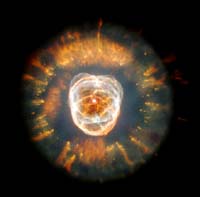 Washington - January 24, 2000 - The Hubble Space Telescope has captured a majestic view of a planetary nebula, the glowing remains of a dying, Sun-like star. This stellar relic, first spied by William Herschel in 1787, is nicknamed the "Eskimo" Nebula (NGC 2392) because, when viewed through ground-based telescopes, it resembles a face surrounded by a fur parka.
In this Hubble telescope image, the "parka" is really a disk of material embellished with a ring of comet-shaped objects, with their tails streaming away from the central, dying star. The Eskimo's "face" also contains some fascinating details. Although this bright central region resembles a ball of twine, it is, in reality, a bubble of material being blown into space by the central star's intense "wind" of high-speed material. The planetary nebula began forming about 10,000 years ago, when the dying star began flinging material into space. The nebula is composed of two elliptically shaped lobes of matter streaming above and below the dying star. In this photo, one bubble lies in front of the other, obscuring part of the second lobe. Scientists believe that a ring of dense material around the star's equator, ejected during its red giant phase, created the nebula's shape. This dense waist of material is plodding along at 72,000 miles per hour (115,000 kilometers per hour), preventing high-velocity stellar winds from pushing matter along the equator. Instead, the 900,000-mile-per-hour (1.5-million-kilometer-per-hour) winds are sweeping the material above and below the star, creating the elongated bubbles. The bubbles are not smooth like balloons but have filaments of denser matter. Each bubble is about 1 light-year long and about half a light-year wide. Scientists are still puzzled about the origin of the comet-shaped features in the "parka." One possible explanation is that these objects formed from a collision of slow- and fast-moving gases.
The Eskimo Nebula is about 5,000 light-years from Earth in the constellation Gemini. The picture was taken Jan. 10 and 11, 2000, with the Wide Field and Planetary Camera 2. The nebula's glowing gases produce the colors in this image: nitrogen (red), hydrogen (green), oxygen (blue), and helium (violet).
SPACE SCOPES
|
|
| ||||||||
| The content herein, unless otherwise known to be public domain, are Copyright 1995-2016 - Space Media Network. All websites are published in Australia and are solely subject to Australian law and governed by Fair Use principals for news reporting and research purposes. AFP, UPI and IANS news wire stories are copyright Agence France-Presse, United Press International and Indo-Asia News Service. ESA news reports are copyright European Space Agency. All NASA sourced material is public domain. Additional copyrights may apply in whole or part to other bona fide parties. Advertising does not imply endorsement, agreement or approval of any opinions, statements or information provided by Space Media Network on any Web page published or hosted by Space Media Network. Privacy Statement All images and articles appearing on Space Media Network have been edited or digitally altered in some way. Any requests to remove copyright material will be acted upon in a timely and appropriate manner. Any attempt to extort money from Space Media Network will be ignored and reported to Australian Law Enforcement Agencies as a potential case of financial fraud involving the use of a telephonic carriage device or postal service. |