| . |  |
. |
| . | |
. |


Space Shows Way To Europe's Renewable Energy Future
How can we more effectively harness the free and endless energy resources of the Sun, wind and water? One answer is orbiting above us. Satellites provide us with a wide variety of data that can help with many aspects of the building and management of renewable energy plants. ESA recently held a workshop at its Frascati-based centre in Italy, attended by representatives of the Earth Observation (EO) service industry together with renewable energy companies and utilities to explore how satellite data can be exploited in this area. And this month the Earth Observation (EO) Market Development section of ESA announced plans to fund an international project to foster the development of EO-based services for the wind, solar and hydropower energy industries. Europe is already the world leader in renewable energy. Denmark is flanked by some 2,300 wind turbines, supplying 15% of its electricity. Germany is on course to have 140,000 solar-panelled rooftops by 2005. More than half of Scandinavia's energy comes from hydropower. And as part of Kyoto-protocol efforts to curb carbon emissions, the European Commission has pledged that renewable sources will make up 22% of Europe's energy supply by the end of this decade (up from 14% in 1997). As the importance of the renewables sector grows, the idea has arisen to use satellite data for better exploitation of its various energy sources.
Solar power And speaking at the Frascati workshop, Murray Cameron of the European Photovoltaic Industry Association (EPIA) explained how space data could also be used to help quantify the potential power expected from a given solar plant and its associated performance.
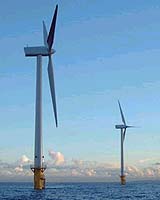
Wind energy Offshore windfarms are more productive and most future farms are likely to be built in the coastal ocean due to the saturation of land-based sites. To be viable, offshore developments have to generate at least 200 MW, and to build on such a scale costs at least Euro 300 million. The problem is there is hardly any offshore wind data available to industry. Furthermore, existing data record mainly extreme wind events. And to gather in-situ data from a single offshore meteorological mast can cost a million Euros a year, and provides data only for a small area. But using satellites enables a shift from a local to a global view. The sophisticated Synthetic Aperture Radar (SAR) instruments on board ESA's ERS-2 and Envisat can provide high-resolution 100-metre data on the wind field, and a decade-long data archive is available. Other space-borne instruments could come into play through the cycle of wind turbine planning, construction and maintenance. Optical sensors such as Envisat's Medium Resolution Imaging Spectrometer (MERIS) could be used to carry out environmental impact assessments. And satellite images could also be used for marine traffic management during initial construction and later repair work, as well as for daily energy production forecasting.
Hydropower In Norway for instance -- where hydropower supplies almost all the country's energy needs -- around half of all winter precipitation accumulates on the ground throughout the winter as snow. By measuring snow coverage and thickness, then combining this information with meteorological data such as ground temperature, run-off can be accurately modelled and predicted. Optical EO data is already used to monitor snow coverage, together with ground observation. The operational use of optical data remains however severely limited by the presence of clouds. But radar instruments such as those aboard ERS-2 and Envisat have the potential to greatly supplement the amount of snow data gathered, because they can see right through clouds. Anders Rognes of the Norwegian Computing Center told the Frascati workshop how they have worked with Statkraft, a major Scandinavian hydropower company, to prepare a snow reservoir mapping system called SnowStar. The SnowStar server automatically processes satellite information of several different systems, including radar imagery, for display within geographic information system (GIS) software.
The next step "The ESA gathering was very useful in getting service providers and potential service users together," said workshop participant Marion Schroedter-Homscheidt of the German Aerospace Centre DLR. "Now the Invitation to Tender gives both sides the opportunity to turn the ideas we discussed into reality." Related Links ESA Renewable Energy Workshop EO Market Development Inivitation to Tender AO 4364 EC Renewables Directive European Photovoltaic Industry Association Garrad Hassan Norwegian Computing Center SpaceDaily Search SpaceDaily Subscribe To SpaceDaily Express  ORNL Negotiating With Companies On Cryogenic Systems
 Oak Ridge - Jul 29, 2003
The Department of Energy's Oak Ridge National Laboratory has entered into negotiations for awarding two three-year contracts worth more than $8 million to develop advanced cryogenic systems to support new high-temperature superconductors.
|
|
| |||||||||
| The content herein, unless otherwise known to be public domain, are Copyright 1995-2016 - Space Media Network. All websites are published in Australia and are solely subject to Australian law and governed by Fair Use principals for news reporting and research purposes. AFP, UPI and IANS news wire stories are copyright Agence France-Presse, United Press International and Indo-Asia News Service. ESA news reports are copyright European Space Agency. All NASA sourced material is public domain. Additional copyrights may apply in whole or part to other bona fide parties. Advertising does not imply endorsement, agreement or approval of any opinions, statements or information provided by Space Media Network on any Web page published or hosted by Space Media Network. Privacy Statement All images and articles appearing on Space Media Network have been edited or digitally altered in some way. Any requests to remove copyright material will be acted upon in a timely and appropriate manner. Any attempt to extort money from Space Media Network will be ignored and reported to Australian Law Enforcement Agencies as a potential case of financial fraud involving the use of a telephonic carriage device or postal service. |