


. 24/7 Space News .


CLIMATE SCIENCE
Scientist play down 'tipping point' theory
by Staff Writers
Adelaide, Australia (UPI) Feb 28, 2013


Results from Antarctic lake drill on hold
St. Petersburg, Russia (UPI) Mar 1, 2013 - Russian scientists obtaining samples from a frozen Antarctic lake say it could take months to determine if life exists in the water from 2 miles beneath ice.

"Let's maintain the intrigue a little longer," Vladimir Lipenkov, a climatologist at Russia's Arctic and Antarctic Research Institute, told RIA Novosti.

The samples from Lake Vostok, an ancient lake sealed under miles of ice, are on a research vessel, which is to will return to St. Petersburg, Russia, from the Southern Hemisphere in May, Lipenkov said.

Analysis of the samples will then start, he said.

The largest sub-glacial lake in Antarctica, Lake Vostok may contain unique microscopic life-forms that evolved after it was isolated from the outside world by the ice sheet 18 million years ago, the researchers said.

The scientists completed a project to drill through the ice into the lake and gathered samples of water that froze in the borehole in January.

The Antarctic findings could give clues to life under extreme conditions similar to those found outside the Earth, Valery Lukin, head of the Russian Antarctic Expedition, said.

"I'd compare it to space research," Lukin said. "Understanding of the sub-glacial environment expands human knowledge, the same as studying other objects of the solar system."

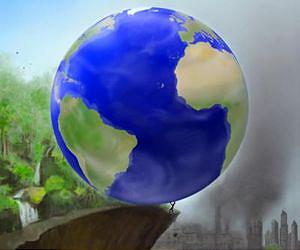
A doomsday-like scenario of sudden, irreversible change to the Earth's ecology -- a tipping point -- is not supported by science, Australian researchers say.

Writing in the journal Trends in Ecology and Evolution, scientists from the University of Adelaide, along with U.S. and British colleagues, argue that global-scale ecological tipping points are unlikely and that ecological change over large areas seem to follow a more gradual, smooth pattern.

"This is good news because it says that we might avoid the doom-and-gloom scenario of abrupt, irreversible change," Barry Brook, lead author of the paper and Director of Climate Science at the University of Adelaide, said. "A focus on planetary tipping points may both distract from the vast ecological transformations that have already occurred, and lead to unjustified fatalism about the catastrophic effects of tipping points."

The scientists say they refute recent efforts to define "planetary tipping points" -- critical levels of biodiversity loss or land-use change that would have global effect -- often presented as fact to policy makers.

"An emphasis on a point of no return is not particularly helpful for bringing about the conservation action we need," Brook said in a university release Thursday..

A planetary tipping point, the authors suggest, could theoretically occur if ecosystems across Earth respond in similar ways to the same human pressures, or if there are strong connections between continents that allow for rapid diffusion of impacts across the planet.

"These criteria, however, are very unlikely to be met in the real world," Brook said. "First, ecosystems on different continents are not strongly connected. Second, the responses of ecosystems to human pressures like climate change or land-use change depend on local circumstances and will therefore differ between localities."

The four principal drivers of terrestrial ecosystem change -- climate change, land-use change, habitat fragmentation and biodiversity loss -- are unlikely to induce global tipping points, the researchers said.

.


Related Links
Climate Science News - Modeling, Mitigation Adaptation


Comment on this article via your Facebook, Yahoo, AOL, Hotmail login.

Share this article via these popular social media networks
del.icio.usdel.icio.us DiggDigg RedditReddit GoogleGoogle


Memory Foam Mattress Review

Newsletters :: SpaceDaily Express :: SpaceWar Express :: TerraDaily Express :: Energy Daily
XML Feeds :: Space News :: Earth News :: War News :: Solar Energy News

Get Our Free Newsletters
Space - Defense - Environment - Energy - Solar - Nuclear

...


CLIMATE SCIENCE
Geoengineering by coalition
Washington DC (SPX) Feb 26, 2013
Solar geoengineering is a proposed approach to reduce the effects of climate change due to greenhouse gasses by deflecting some of the sun's incoming radiation. This type of proposed solution carries with it a number of uncertainties, however, including geopolitical questions about who would be in charge of the activity and its goals. New modeling work from Carnegie's Katharine Ricke and K ... read more


CLIMATE SCIENCE
Water On The Moon: It's Been There All Along

Building a lunar base with 3D printing

US, Europe team up for moon fly-by

Russia to Launch Lunar Mission in 2015

CLIMATE SCIENCE
Lab Instruments Inside Curiosity Eat Mars Rock Powder

First-ever space tourist plans mission to Mars

Mars rover ingests rock powder for tests

Opportunity Is On A Rock Hunt

CLIMATE SCIENCE
Tech sector rides on rich list

Brazil inventor struggles to collect royalties

Stanford scientist closes in on a mystery that impedes space exploration

U.S. research to be free online

CLIMATE SCIENCE
Welcome Aboard Shenzhou 10

Reshuffle for Tiangong

China to launch 20 spacecrafts in 2013

CLIMATE SCIENCE
ESA's Columbus Biolab Facility

SpaceX set for third mission to space station

Record Number of Students Control ISS Camera

NASA briefly loses contact with space station

CLIMATE SCIENCE
SpaceX Optimistic Despite Dragon Capsule Mishap

'Faulty Ukrainian Parts' Blamed for Zenit Launch Failure

The light-lift member of Arianespace's launcher family is readied for its second mission

SpaceX 2 Launch Set for March 1

CLIMATE SCIENCE
NASA's Kepler Mission Discovers Tiny Planet System

Kepler helps astronomers find tiny exo planet

Searching for a Pale Blue SPHERE in the Universe

Earth-like planets are right next door

CLIMATE SCIENCE
Atoms with Quantum-Memory

Big data: Searching in large amounts of data quickly and efficiently

Creating your own animated 3D characters and scenes for the web

Taiwan turns plastic junk into blankets, dolls


The content herein, unless otherwise known to be public domain, are Copyright 1995-2012 - Space Media Network. AFP, UPI and IANS news wire stories are copyright Agence France-Presse, United Press International and Indo-Asia News Service. ESA Portal Reports are copyright European Space Agency. All NASA sourced material is public domain. Additional copyrights may apply in whole or part to other bona fide parties. Advertising does not imply endorsement,agreement or approval of any opinions, statements or information provided by Space Media Network on any Web page published or hosted by Space Media Network. Privacy Statement