


|
|
|
|
|
|
|
|
|
|
|


| . |  |
. |
|
|
|
 by Staff Writers Washington DC (SPX) May 24, 2012
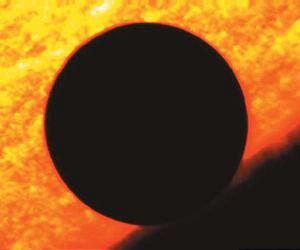
A few hours before sunset on June 5th, 2012 residents of the Washington, DC metropolitan area will have a chance to witness one of the rarest celestial phenomena known: a "Transit of Venus". Such an event occurs when the planet Venus passes almost exactly between the Earth and the Sun, and they are incredibly rare. Since first predicted by the German mathematician and astronomer Johannes Kepler in the 17th Century, only six Transits of Venus have been observed. Weather permitting, this will be the seventh. Transits of Venus occur at regular intervals that repeat over a 243-year period. Intervals between successive transits are 8 years, 105.5 years, 8 years, and 121.5 years. The next Transit of Venus won't occur until December 11, 2117, and it will not be visible from Washington! Kepler predicted the transit of December 7, 1631 but died before the event occurred. The next transit, on December 4, 1639, was observed by only two individuals, Jeremiah Horrocks and William Crabtree, from England. In 1677 Edmond Halley (of comet fame) observed a transit of Mercury from St. Helena Island and realized that such events, if observed from many widely-spaced sites, could provide a geometric measure of the scale of the solar system. His work led to several far-flung expeditions to observe the Venus transits of June 6, 1761 and June 3, 1769. One of the British expeditions to the latter transit was led by Captain James Cook. Results from these expeditions were mixed, but enough experience was gained to attempt observations of the next series in the 19th Century. The transits of December 9, 1874 and December 6, 1882 were met with an armada of scientific expeditions equipped with state-of-the-art astronomical instruments. The U.S. Congress funded and outfitted eight separate expeditions for each event and placed overall scientific direction of these teams under the command of the U.S. Naval Observatory (USNO). Once again the results were inconclusive, but many of the instruments from these expeditions are still in the Observatory's possession. The 20th Century saw no Transits of Venus; the next one occurred on June 8, 2004. By this time the size of the solar system had been well-established, so observing the transit became more of an historical event than a scientific one. This year's transit will begin about 2.5 hours before sunset in the Washington area at 6:04 pm Eastern Daylight Time. It will occur earlier in the day and at a higher altitude as one moves farther west, but no place in the "lower 48" will see the event in its entirety. Residents of Alaska, Hawai'i and the U.S. Pacific Territories are the only Americans who will see the complete event. At the USNO, we will once again attempt to observe the transit with one of our historic 5-inch Alvan Clark Transit of Venus telescopes. This particular instrument, Number 856, successfully observed the transit of 1874 from Vladivostok, Siberia and the 1882 transit from San Antonio, Texas. It was employed to successfully observe the 2004 transit following restoration by the Observatory's Instrument Shop. If successful this year we will have the only instrument known to have observed four of the seven transits that humans have recorded. Observing the transit will not require a telescope; the disc of Venus is large enough to be seen with the unaided eye. However, extreme precaution must be taken when observing the event or permanent eye damage and/or blindness will occur. The USNO strongly recommends that people wishing to observe the transit contact any of the local science centers, planetariums, or amateur astronomy clubs as they will have the proper equipment to enjoy this rare event. A listing of such regional organizations may be found on the USNO's web site. Founded in 1830, the USNO continues to function as an operational Navy unit under the Commander, Naval Meteorology and Oceanography Command and United States Fleet Forces Command, maintaining and disseminating the DoD's official timescale used by GPS and other Defense satellite systems, as well as collecting astrometric information required to operate a wide variety of strategic systems such as the B2, Trident ICBMs, and ISR satellite systems.
Related Links US Naval Observatory Public Affairs Office Venus Express News and Venusian Science
|
|
|
| The content herein, unless otherwise known to be public domain, are Copyright 1995-2014 - Space Media Network. AFP, UPI and IANS news wire stories are copyright Agence France-Presse, United Press International and Indo-Asia News Service. ESA Portal Reports are copyright European Space Agency. All NASA sourced material is public domain. Additional copyrights may apply in whole or part to other bona fide parties. Advertising does not imply endorsement,agreement or approval of any opinions, statements or information provided by Space Media Network on any Web page published or hosted by Space Media Network. Privacy Statement |
 del.icio.us
 Digg
Digg Reddit
 Google