


. 24/7 Space News .


STELLAR CHEMISTRY
Experiment Examining a SLICE of the Interstellar Medium
by Keith Koehler for NASA's Wallops Flight Facility
Wallops VA (SPX) Dec 19, 2012


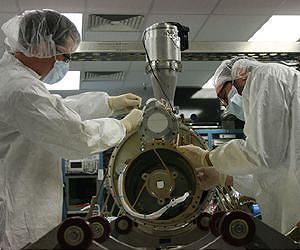
University of Colorado science team work on the SLICE instrument during integration testing at NASA's Wallops Flight Facility. Credit: Berit Bland/Wallops. For a larger version of this image please go here.

When you look up at the stars at night, the space between stars looks empty. But, yes there is something there. It's called the interstellar medium. An experiment from the University of Colorado will fly on a NASA suborbital sounding rocket from the White Sands Missile Range in New Mexico on December 15 to study this space between the stars.

The Sub-orbital Local Interstellar Cloud Experiment (SLICE) will use an 8-inch diameter telescope and spectrograph covering the far-ultraviolet wavelength range from 102 - 107 nm.

Kevin France, the SLICE principal investigator from Colorado, said "We hope to observe four hot stars in the constellations of Orion and Taurus. We use these stars as background sources to study the composition, temperature, and ionization state of material in the interstellar medium."

"This particular ultraviolet spectral window can only be accessed from space. These spectra will enable us to measure several phases of the interstellar medium: from the cool molecular gas that will eventually form the next generation of stars, to the hot gas that is driven into the interstellar medium when massive stars die in supernova explosions," he said.

So, why the interest in this space in space? The immediate interstellar environment determines the structure of the heliosphere. The heliosphere controls the cosmic ray flux seen in the inner solar system which has a profound effect on the Earth, influencing cloud cover, lightning frequency, upper atmosphere chemistry and even mutation rates of surface, deep-earth and deep-sea organisms.

The interaction of stellar winds and the interstellar medium is a general phenomenon, and thus all stars and planetary systems will have the astrospheric interfaces. Understanding the structure of the local interstellar medium is important in evaluating the cosmic ray environment and the potential habitability of nearby exoplanets.

.


Related Links
Sounding-rockets at NASA
Stellar Chemistry, The Universe And All Within It


Comment on this article via your Facebook, Yahoo, AOL, Hotmail login.

Share this article via these popular social media networks
del.icio.usdel.icio.us DiggDigg RedditReddit GoogleGoogle


Memory Foam Mattress Review

Newsletters :: SpaceDaily Express :: SpaceWar Express :: TerraDaily Express :: Energy Daily
XML Feeds :: Space News :: Earth News :: War News :: Solar Energy News

Get Our Free Newsletters
Space - Defense - Environment - Energy - Solar - Nuclear

...


Year In Space 2013 Wall Calendar


STELLAR CHEMISTRY
Unvieling diffuse x-ray emission from nearby galaxies
White Sands NM (SPX) Dec 12, 2012
NASA will launch an astrophysics mission to study the Diffuse X-ray emission from the Local galaxy (DXL) December 9 from the White Sands Missile Range in New Mexico. The goal of this flight is to identify how much of that diffuse x-ray emission comes from our solar system from the solar wind charge exchange process, and how much comes from outside our solar system from hot interstellar pla ... read more


STELLAR CHEMISTRY
NASA probes crash into the moon

Apollo's Lunar Dust Data Being Restored

GRAIL Lunar Impact Site Named for Astronaut Sally Ride

No plans of sending an Indian on moon

STELLAR CHEMISTRY
Opportunity For Some Shoulder Workout At Copper Cliff

Clays on Mars: More Plentiful Than Expected

Curiosity Rover Explores 'Yellowknife Bay'

Charitum Montes: a cratered winter wonderland

STELLAR CHEMISTRY
TDRS-K Arrives at Kennedy for Launch Processing

Sierra Nevada Corporation Selected by NASA to Receive Human Spaceflight Certification Products Contract

What happens to plant growth when you remove gravity?

To reach final frontier, NASA can't go it alone: analysts

STELLAR CHEMISTRY
Mr Xi in Space

China plans manned space launch in 2013: state media

China to launch manned spacecraft

Tiangong 1 Parked And Waiting As Shenzhou 10 Mission Prep Continues

STELLAR CHEMISTRY
Three astronauts blast off for ISS in Russian craft

New Trio Launches to Join Expedition 34

Medical Ops, Fan Checks for Space Crew; New Trio Checks Soyuz

ISS Orbit Raised Ahead of Crew Arrival

STELLAR CHEMISTRY
Ariane 5 ECA orbits Skynet 5D and Mexsat Bicentenario satellites

Payload integration complete for final 2012 Ariane 5 mission

Arctic town eyes future as Europe's gateway to space

ISRO planning 10 space missions in 2013

STELLAR CHEMISTRY
Venus transit and lunar mirror could help astronomers find worlds around other stars

Nearby star is good candidate for Earth-like planets

Astronomers discover and 'weigh' infant solar system

Search for Life Suggests Solar Systems More Habitable than Ours

STELLAR CHEMISTRY
Berkeley Lab Scientists Developing Quick Way to ID People Exposed to Ionizing Radiation

MEXSAT Bicentenario Satellite Sends First Signals from Space

Missile Defense Agency awards Raytheon contract modification for AN/TPY-2 radar

Fitting 'smart' mobile phone with magnifying optics creates 'real' cell phone


The content herein, unless otherwise known to be public domain, are Copyright 1995-2012 - Space Media Network. AFP, UPI and IANS news wire stories are copyright Agence France-Presse, United Press International and Indo-Asia News Service. ESA Portal Reports are copyright European Space Agency. All NASA sourced material is public domain. Additional copyrights may apply in whole or part to other bona fide parties. Advertising does not imply endorsement,agreement or approval of any opinions, statements or information provided by Space Media Network on any Web page published or hosted by Space Media Network. Privacy Statement