|
 |
 |
 |
 |
 |
 |
 |
 |
 |

| . |  |
. |
Double Volcanic Eruption In Eastern Russia
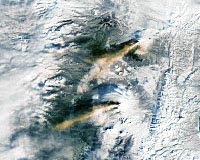
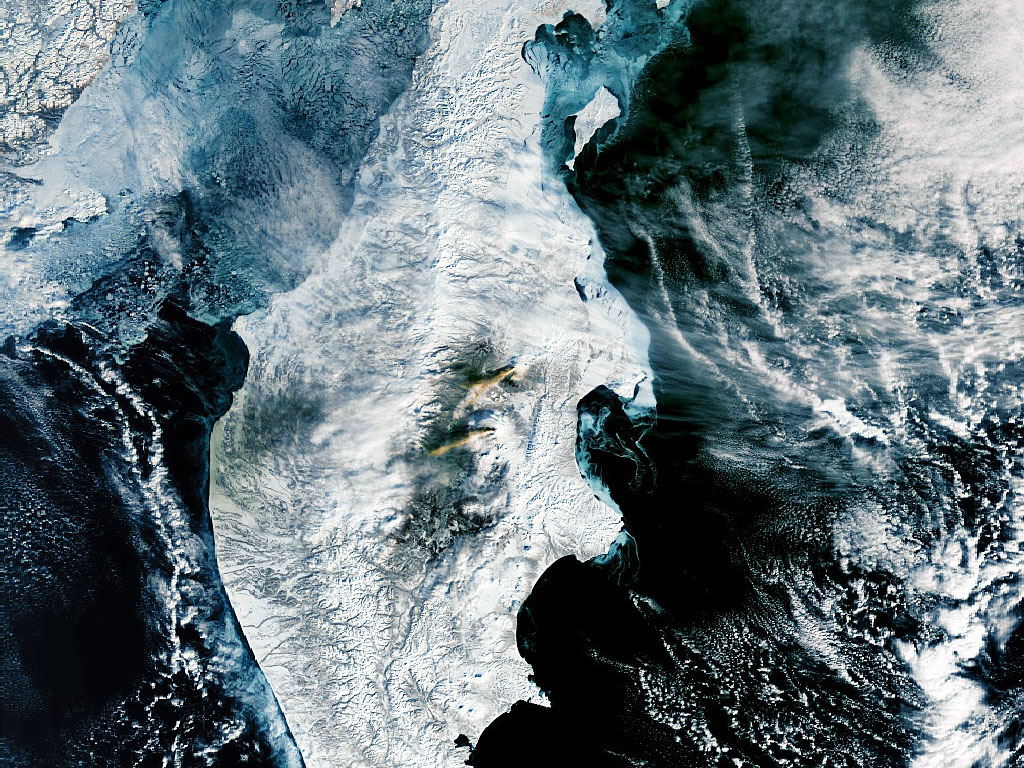
Acquired from orbit 800 kilometres away, this Envisat image shows two volcanoes erupting simultaneously on Russia's snowy Kamchatka Peninsula this week. Located in the Russian Far East, the Kamchatka Peninsula is a landscape covered with volcanoes, part of the Pacific 'Ring of Fire'. Two stratovolcanoes, Kliuchevskoi and Shiveluch are currently erupting simultaneously. The more southerly 4835-metre-high Kliuchevskoi volcano began its latest eruption on 17 January 2005. By 7 March its consequent lava flow had reached the Erman glacier and started to melt it, causing a threat of potential mudslides. The hot volcanic material in contact with the surrounding ice and snow caused secondary explosions, hurling material as far as eight kilometres into the air. Above it is Kamchatka's most northerly active volcano Shiveluch � also known as Sheveluch. It is 3283 metres high and started its latest eruption on 27 February 2005. The erupting material covers an area over 700 kilometres across with a layer of ash about 150 kilometres wide and eight centimetres thick, extending westward to the Okhotsk Sea. A ten-km-wide lava flow destroyed the Shiveluch seismological station, located about eight km from the volcano. Russia's Novosti RIA news agency reports that the village of Klyuchi located between the two volcanoes is suffering periodic ash falls but is otherwise safe. Aviation is at greater threat, with volcanic ash particles capable of disabling aircraft engines: Kamchatka is on a major airline route, and aircraft have had to divert around eruptions in the past. The image was acquired by Envisat's Medium Resolution Imaging Spectrometer (MERIS) in Reduced Resolution Mode, with a spatial resolution of 300 metres and a width of 1284 km. It was processed for ESA by Brockmann Consult. Related Links SpaceDaily Search SpaceDaily Subscribe To SpaceDaily Express  Analysis: A Volcano's Most Public Eruption
 San Francisco (UPI) Dec 20, 2004
There are several, highly unusual aspects of the 2004 eruption of Mount St. Helens, but perhaps the most extraordinary is how scientists and interested lay people worldwide are getting to watch it happen up close in real time.
|
|
| |||||||||
| The content herein, unless otherwise known to be public domain, are Copyright 1995-2016 - Space Media Network. All websites are published in Australia and are solely subject to Australian law and governed by Fair Use principals for news reporting and research purposes. AFP, UPI and IANS news wire stories are copyright Agence France-Presse, United Press International and Indo-Asia News Service. ESA news reports are copyright European Space Agency. All NASA sourced material is public domain. Additional copyrights may apply in whole or part to other bona fide parties. Advertising does not imply endorsement, agreement or approval of any opinions, statements or information provided by Space Media Network on any Web page published or hosted by Space Media Network. Privacy Statement All images and articles appearing on Space Media Network have been edited or digitally altered in some way. Any requests to remove copyright material will be acted upon in a timely and appropriate manner. Any attempt to extort money from Space Media Network will be ignored and reported to Australian Law Enforcement Agencies as a potential case of financial fraud involving the use of a telephonic carriage device or postal service. |