|
 |
 |
 |
 |
 |
 |
 |
 |
 |

| . |  |
. |
Venus Express Completes Integration And Test Phases
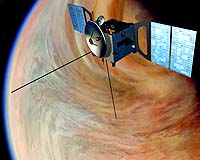
Venus Express, the first European space probe to investigate the planet Venus has completed the development, integration and test phase in Toulouse. Venus Express is being manufactured by EADS Astrium as prime contractor for ESA (European Space Agency). The research probe is scheduled for launch on board a Soyuz-Fregat rocket from the Baikonur Cosmodrome (Kazakhstan) in late October 2005. EADS is the principal shareholder of Starsem, the launch provider, with 35%, Arianespace holding 15%. For two Venusian years (500 Earth days), the probe will investigate the atmosphere of the hottest planet in terms of structure, composition and dynamics. Venus Express, carrying seven scientific instruments (spectrometers, imagers and a plasma analyser) will orbit the second planet of the solar system at an altitude between 250 and 66,000 kilometres by flying above its poles. Analysing and understanding the prevailing conditions in the atmosphere and in the near environment of Venus is of critical importance to understanding long term climatic processes governing the evolution of life on Earth. By re-using both Mars Express spacecraft design and the available instruments from the Mars Express and Rosetta programs, Venus Express meets the triple challenge of achieving its scientific objectives, cost efficiency and its unparalleled development schedule. Venus Express development began in the autumn of 2002. In the last few months the spacecraft has successfully passed its entire environmental test campaign in Intespace Toulouse and is currently undergoing the final functional test prior to Flight Acceptance Review in early July. Departure to Baikonour is planned by August this year.
Specific solar panels for the mission As the Venus mission requires guiding the spacecraft towards the sun the layout of the solar generators has to be very special. The design is necessary for the solar arrays to withstand the high temperature loads encountered during its mission. After Mercury, Venus is the Sun's nearest planet and consequently solar radiation is considerably higher than on Earth. Additionally, the solar arrays will be exposed to the sunlight reflection from the Venusian atmosphere, the so-called albedo. The solar arrays have been designed and qualified for operating temperatures between -167�C and +158�C. It delivers a power of 821 watts in the Earth's orbit and 1,468 watts in the Venusian orbit at the end of its four-year mission. Shortly after launch, Venus Express will unfold its solar arrays which will remain deployed during the whole mission. Related Links SpaceDaily Search SpaceDaily Subscribe To SpaceDaily Express  Magellan Mission Ends As Grounds Controllers Lose Contact
 Pasadena CA (SPX) Oct 13, 2004
The successful five-and-a-half-year mission of NASA's Magellan spacecraft to map the surface and measure the gravity of Venus ended Tuesday when ground controllers lost contact with the spacecraft. Magellan is expected to burn up in the planet's upper atmosphere within two days.
|
|
| |||||||||
| The content herein, unless otherwise known to be public domain, are Copyright 1995-2016 - Space Media Network. All websites are published in Australia and are solely subject to Australian law and governed by Fair Use principals for news reporting and research purposes. AFP, UPI and IANS news wire stories are copyright Agence France-Presse, United Press International and Indo-Asia News Service. ESA news reports are copyright European Space Agency. All NASA sourced material is public domain. Additional copyrights may apply in whole or part to other bona fide parties. Advertising does not imply endorsement, agreement or approval of any opinions, statements or information provided by Space Media Network on any Web page published or hosted by Space Media Network. Privacy Statement All images and articles appearing on Space Media Network have been edited or digitally altered in some way. Any requests to remove copyright material will be acted upon in a timely and appropriate manner. Any attempt to extort money from Space Media Network will be ignored and reported to Australian Law Enforcement Agencies as a potential case of financial fraud involving the use of a telephonic carriage device or postal service. |