|
 |
 |
 |
 |
 |
 |
 |
 |
 |

| . |  |
. |
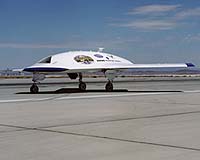
Two Boeing X-45A Unmanned Jets Continue Coordinated Flights
Two military jets flying together may seem routine, but when they are pilotless, tail-less aircraft, routine goes out the window and science fiction springs to mind. Boeing continued to turn science fiction into reality when two X-45A technology demonstrator aircraft made their second and third coordinated flights at NASA's Dryden Flight Research Center, Edwards Air Force Base, Calif. Controlled by a single pilot-operator, the Joint Unmanned Combat Air Systems' (J-UCAS) X-45As, complete with Boeing's latest software build known as Block 3 software, departed in succession and entered coordinated flight over the test range. Known by the call signs "Stingray 01 and 02," the revolutionary aircraft operated together in coordinated flight for more than one hour. During the Dec. 3 mission, the 27-foot-long air vehicles flew successfully in several different formations, demonstrating the ability to autonomously enter and exit coordinated flight based on pre-identified points and showing the ability to dynamically alter the formation in all three axes simultaneously. The previous Block 3 multiple vehicle flight on Nov. 12 demonstrated "4-D" navigation, which allows the vehicles to accurately control time-of-arrival over specified geographic locations in addition to maintaining relative position � a critical capability in tactical operations. "With 42 flights and more than two years of testing under our belts, we're ready to take unmanned systems to the next level," said Darryl Davis, Boeing J-UCAS X-45 vice president and program manager. "Using data from our first coordinated flight in August and others in 2004, we're developing an affordable, effective war fighting system capable of operating autonomously and cooperatively within networked combat environments." Boeing was recently awarded $767 million in funding from the Defense Advanced Research Projects Agency (DARPA) to build and demonstrate three X-45C aircraft, two mission control elements, and to integrate a common operating system technology for the J-UCAS program. Boeing's software used on the X-45As may be offered as a candidate for functionality in J-UCAS' Common Operating System. The first X-45C flight is scheduled to take place in early 2007. The J-UCAS X-45 program is a DARPA/U.S. Air Force/U.S. Navy/Boeing effort to demonstrate the technical feasibility, military utility and operational value of an unmanned air combat system for the Air Force and the Navy. Operational missions for the services may include suppression of enemy air defenses; strike; electronic attack; intelligence, surveillance and reconnaissance; and persistent global attack. The two X-45A technology demonstrators are currently verifying the core functionality of the software necessary for these and related missions. Related Links Boeing SpaceDaily Search SpaceDaily Subscribe To SpaceDaily Express  NASA Takes UAV Flight Tests To Idaho Desert Lands
 Moffett Field (SPX) Dec 09, 2004
Hundreds of miles from the legendary California research centers where pioneering aircraft like the supersonic X-1 were put through their paces, National Aeronautics and Space Administration representatives are pushing the envelope in the Idaho desert with a very different, but equally unique aircraft.
|
|
| ||||||||||
| The content herein, unless otherwise known to be public domain, are Copyright 1995-2016 - Space Media Network. All websites are published in Australia and are solely subject to Australian law and governed by Fair Use principals for news reporting and research purposes. AFP, UPI and IANS news wire stories are copyright Agence France-Presse, United Press International and Indo-Asia News Service. ESA news reports are copyright European Space Agency. All NASA sourced material is public domain. Additional copyrights may apply in whole or part to other bona fide parties. Advertising does not imply endorsement, agreement or approval of any opinions, statements or information provided by Space Media Network on any Web page published or hosted by Space Media Network. Privacy Statement All images and articles appearing on Space Media Network have been edited or digitally altered in some way. Any requests to remove copyright material will be acted upon in a timely and appropriate manner. Any attempt to extort money from Space Media Network will be ignored and reported to Australian Law Enforcement Agencies as a potential case of financial fraud involving the use of a telephonic carriage device or postal service. |