|
 |
 |
 |
 |
 |
 |
 |
 |
 |

| . |  |
. |
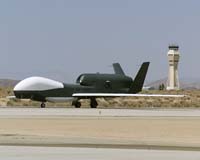
First Production Air Vehicle Of Global Hawk Taxis Out Of Factory
Northrop Grumman's Integrated Systems sector marked the completion of the first production air vehicle of the U.S. Air Force's combat-proven RQ-4A Global Hawk unmanned aerial reconnaissance system early this month. In a ceremony at the company's Antelope Valley Manufacturing Center in Palmdale August 1, dignitaries rolled back a curtain to reveal the air vehicle, called Global Hawk Air Force 1, in its new operational gray-and-white paint scheme. The vehicle will complete a final series of systems tests in preparation for its first flight later this month. Global Hawk is a high-altitude, long-endurance system that provides near real-time intelligence, reconnaissance and surveillance information to battlefield commanders day or night and in all weather conditions. Northrop Grumman is the Air Force's Global Hawk prime contractor. "Northrop Grumman's employees, together with our entire government/industry team, are extremely proud to provide this new combat capability to the U.S. warfighter," said Scott Seymour, Northrop Grumman corporate vice president and Integrated Systems' sector president. "Today's production weapon system has already been proven in combat, which is a tribute to the U.S. Air Force's confidence in the system and the company's legacy of excellence in designing and developing unmanned air vehicles. "Operating in Iraq, Global Hawk's sensors, communications and mission control capabilities provided timely and persistent awareness of the enemy's location, movements and intent. This knowledge contributed significantly to the tempo of advance for what was truly an integrated joint and coalition combat force." Lessons learned from the Global Hawk deployment will be instrumental in understanding how best to integrate unmanned systems with air-land-sea and space forces to create a transformed war fighting capability, added Seymour. Global Hawk Air Force 1 is the eighth Global Hawk air vehicle to be built. Northrop Grumman produced the first seven under the advanced concept technology demonstration (ACTD) phase of the program. Following a final series of systems tests and a flight test program at Edwards Air Force Base, Calif., the vehicle will be delivered to the Air Force's 9th Reconnaissance Wing at Beale AFB near Sacramento, Calif. Although Global Hawk is still in engineering and manufacturing development, and low-rate initial production, it has been successfully deployed by the Air Force twice, first during Operation Enduring Freedom in 2001, and again in 2003 during Operation Iraqi Freedom. Since its first flight in 1998, Global Hawk has logged more than 3,000 flight hours, more than half of them during operational missions. "The entire program team has done an exceptional job in transitioning the program from the ACTD environment to low-rate initial production while supporting the needs of our nation's defense forces," said Carl O. Johnson, Northrop Grumman vice president and Global Hawk program manager. Operating autonomously from takeoff to landing, Global Hawk flies at altitudes up to 65,000 feet for more than 36 hours with a range of 13,500 nautical miles. Using its synthetic aperture radar and electro-optical and infrared sensors, the RQ-4A Global Hawk provides high-quality reconnaissance imagery even in adverse weather conditions, as demonstrated during sandstorms in Iraq. Its high altitude and long endurance allow it to conduct surveillance over an area equal to the size of Illinois in just 24 hours. In addition to its use by the Air Force, Global Hawk has the potential to complement U.S. Navy operations. The Navy is currently procuring two Global Hawk air vehicles for demonstrations of the Global Hawk's maritime surveillance capabilities. Northrop Grumman's Global Hawk program is based at Integrated Systems' Unmanned Systems unit in San Diego, Calif. The company performs final assembly at its Antelope Valley Manufacturing Center in Palmdale. Related Links Northrop Grumman's Integrated Systems SpaceDaily Search SpaceDaily Subscribe To SpaceDaily Express  Zinc-Air Battery Powers Dragon Eye Unmanned Drone
 New York - Jun 27, 2003
A prototype zinc-air battery developed by Arotech Corp's Electric Fuel subsidiary has powered a Dragon Eye unmanned drone for the first time in a flight test in California.
|
|
| |||||||||
| The content herein, unless otherwise known to be public domain, are Copyright 1995-2016 - Space Media Network. All websites are published in Australia and are solely subject to Australian law and governed by Fair Use principals for news reporting and research purposes. AFP, UPI and IANS news wire stories are copyright Agence France-Presse, United Press International and Indo-Asia News Service. ESA news reports are copyright European Space Agency. All NASA sourced material is public domain. Additional copyrights may apply in whole or part to other bona fide parties. Advertising does not imply endorsement, agreement or approval of any opinions, statements or information provided by Space Media Network on any Web page published or hosted by Space Media Network. Privacy Statement All images and articles appearing on Space Media Network have been edited or digitally altered in some way. Any requests to remove copyright material will be acted upon in a timely and appropriate manner. Any attempt to extort money from Space Media Network will be ignored and reported to Australian Law Enforcement Agencies as a potential case of financial fraud involving the use of a telephonic carriage device or postal service. |