|
 |
 |
 |
 |
 |
 |
 |
 |
 |

| . |  |
. |
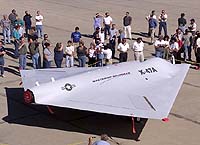
X-47A Pegasus UAV Rolled Out
Northrop Grumman Corporation's Integrated Systems Sector (ISS), headquartered here, announced today that it has completed production of the X-47A Pegasus, a company-funded, unmanned air vehicle that will be used to demonstrate aerodynamic qualities suitable for autonomous operation from an aircraft carrier. The X-47A was rolled out of a hangar in Mojave, Calif., at a celebration today for employees while a full-scale model of the aircraft was displayed at Air Demonstration 2001 at NAS Patuxent River's Webster Field, Md. "Pegasus will demonstrate the suitability of unmanned aerial vehicles (UAV's) for aircraft carrier operations, continuing Northrop Grumman's legacy of investing in leading-edge technologies and innovative concepts to meet emerging defense needs," said Scott J. Seymour, ISS vice president for Air Combat Systems. "UAV's represent a transformational capability that can cost-effectively augment manned systems. We are working closely with our customers to leverage the synergy of manned and unmanned aircraft to accomplish current and future mission requirements." David Mazur, Northrop Grumman's X-47A Pegasus program manager, noted that the company made the decision to invest in an unmanned demonstration air vehicle in July 2000. "To go from program start to a finished air vehicle in one year's time is quite an accomplishment and a tribute to our employees and the industry team that worked on Pegasus," Mr. Mazur said. In particular, Northrop Grumman worked with Scaled Composites, Mojave, Calif., on building the air vehicle. The first event of its kind, Air Demonstration 2001 is being held in conjunction with the Association for Unmanned Vehicle Systems International annual symposium and exhibition. In addition to several of the company's UAV's on display at Webster Field, Northrop Grumman will have an exhibit at the symposium. Northrop Grumman programs on display at Webster Field include a full-scale Pegasus model; a one-fifth scale model of the Global Hawk high-altitude, long endurance reconnaissance system; a full-scale Miniature Air-Launched Decoy (MALD) model; the Fire Scout vertical takeoff and landing tactical UAV (VTUAV); and Firebee and Chukar aerial targets. The Global Hawk UAV system produced for the U.S. Air Force will provide battlefield commanders near real-time, high-resolution, reconnaissance imagery. The MALD, an Advanced Concept Technology Demonstration program, will provide the Air Force with the ability to achieve air superiority by confusing enemy air defense systems. The VTUAV will be able to fly from any "air capable" combat ship for real-time reconnaissance and targeting missions. The BQM-34 Firebee's primary mission is to simulate tactical threats by enemy aircraft and missiles for defense readiness training, air-to-air combat training and the development and evaluation of weapons systems. The Chukar is the international version of the BQM-74, which flies more than 80 percent of the U.S. Navy's airborne target training missions around the world. The Pegasus demonstrator which rolled out today in Mojave will be moved next month to the company's facility in El Segundo, Calif., for a series of systems checkout tests to prepare it for first flight, expected by the end of this year. Northrop Grumman received the X-47A designation for Pegasus from the Air Force earlier this year. The "X" (experimental) designation acknowledges Pegasus' significance as a program that will advance challenging aviation concepts. The results of the Pegasus demonstration effort will be used in Northrop Grumman's continuing work on a naval unmanned combat air vehicle (UCAV-N). Under its UCAV-N contract with the Defense Advanced Research Projects Agency (DARPA) and the Navy, Northrop Grumman is performing trade studies, analysis and preliminary design. The goal of the joint DARPA/Navy project is to demonstrate the technical feasibility for a UCAV-N system to effectively and affordably conduct sea-based 21st century suppression of enemy air defenses, strike and surveillance missions within the emerging global command and control architecture. Related Links More Rollout Pixs Northrop Grumman Integrated Systems Sector SpaceDaily Search SpaceDaily Subscribe To SpaceDaily Express  UAV Gets X Rating
 Le Bourget - June 16, 2001
Northrop Grumman Integrated Systems Sector (ISS) has received an 'X' designation for the company's Pegasus demonstration aircraft. Global Hawk Operating Base Selected  Langley AFB (AFPN) July 27, 2001
The US Air Force has selected Beale Air Force Base, Calif., as the first Global Hawk main operating base. Air Force officials recently completed an environmental assessment and found basing 18 of the unmanned aerial vehicles at Beale would result in no significant environmental impacts.
|
|
| |||||||||
| The content herein, unless otherwise known to be public domain, are Copyright 1995-2016 - Space Media Network. All websites are published in Australia and are solely subject to Australian law and governed by Fair Use principals for news reporting and research purposes. AFP, UPI and IANS news wire stories are copyright Agence France-Presse, United Press International and Indo-Asia News Service. ESA news reports are copyright European Space Agency. All NASA sourced material is public domain. Additional copyrights may apply in whole or part to other bona fide parties. Advertising does not imply endorsement, agreement or approval of any opinions, statements or information provided by Space Media Network on any Web page published or hosted by Space Media Network. Privacy Statement All images and articles appearing on Space Media Network have been edited or digitally altered in some way. Any requests to remove copyright material will be acted upon in a timely and appropriate manner. Any attempt to extort money from Space Media Network will be ignored and reported to Australian Law Enforcement Agencies as a potential case of financial fraud involving the use of a telephonic carriage device or postal service. |