|
 |
 |
 |
 |
 |
 |
 |
 |
 |

| . |  |
. |
Global Hawk Clocks Up 1,000 Hours
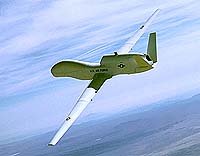
Northrop Grumman's Global Hawk unmanned aerial reconnaissance system developed for the US Air Force has clocked up more than 1,000 flight hours during its 81st flight while taking part in joint US-Australian wargames off eastern Australia. The mission was the first in a series of flights conducted as part of Tandem Thrust, the annual joint Royal Australian Navy/U.S. Navy exercise. During the May 10 flight, the vehicle flew for 25.2 hours and reached a maximum altitude of 63,400 feet, bringing its flight hour total to 1,071.1 hours. During its first flight on Feb. 28, 1998, Global Hawk flew for one hour over Edwards AFB, Calif., at an altitude of 32,000 feet. Since then, the system has set world records for altitude, endurance and distance for jet-powered unmanned aircraft. Global Hawk, a high-altitude, long-endurance system under development to provide military field commanders with high-resolution, near real-time imagery of large geographic areas, is in Australia for a series of missions to demonstrate maritime surveillance and coastal watch capabilities to the Australian government. The UAV is scheduled to make its return flight to the U.S. in early June. Global Hawk is under development for the Air Force's Aeronautical Systems Center at Wright-Patterson AFB, Ohio. Northrop Grumman ISS's Air Combat Systems business area is the prime contractor, with work performed at its Unmanned Systems facilities in San Diego and Palmdale, Calif. Related Links SpaceDaily Search SpaceDaily Subscribe To SpaceDaily Express  Northrop Grumman's Fire Scout VTUAV Enters Initial Production
 San Diego, May 7, 2001
Northrop Grumman's Fire Scout Vertical Takeoff and Landing Unmanned Aerial Vehicle (VTUAV) system moves into low-rate initial production (LRIP) with a $14.2 million contract from the U.S. Navy's Naval Air Systems Command. The company's Integrated Systems Sector (ISS) received the award recently for the first of three planned LRIP options.
|
|
| |||||||||
| The content herein, unless otherwise known to be public domain, are Copyright 1995-2016 - Space Media Network. All websites are published in Australia and are solely subject to Australian law and governed by Fair Use principals for news reporting and research purposes. AFP, UPI and IANS news wire stories are copyright Agence France-Presse, United Press International and Indo-Asia News Service. ESA news reports are copyright European Space Agency. All NASA sourced material is public domain. Additional copyrights may apply in whole or part to other bona fide parties. Advertising does not imply endorsement, agreement or approval of any opinions, statements or information provided by Space Media Network on any Web page published or hosted by Space Media Network. Privacy Statement All images and articles appearing on Space Media Network have been edited or digitally altered in some way. Any requests to remove copyright material will be acted upon in a timely and appropriate manner. Any attempt to extort money from Space Media Network will be ignored and reported to Australian Law Enforcement Agencies as a potential case of financial fraud involving the use of a telephonic carriage device or postal service. |