
 |
 |
 |
 |
 |
 |
 |
 |
 |
 |

| . |  |
. |
Sunspots Jive With Shades Boulder - October 18, 1999 - The Chinese noticed dark spots on the sun as early as 25 B.C. and Galileo gazed at them through his telescope in 1611, but they have remained cloaked in mystery over the centuries. Now, researchers at the National Center for Atmospheric Research (NCAR) in Boulder, Colorado, have found bright rings around eight sunspots. The presence of these rings sheds light on why sunspots are dark. The research is published this week (October 14) in the journal Nature. NCAR's primary sponsor is the National Science Foundation (NSF).
According to lead author, Mark Rast, the rings' presence supports the idea that the spots appear dark because their magnetic fields block heat transport. Caption: A sunspot and its penumbra observed in the CaIIK (calcium) band of the solar spectrum. The brightest areas around the penumbra are vertical magnetic flux tubes. The gray, cloudlike shapes are probably convection cells that release heat previously suppressed within the spot. These lie in the ring region surrounding the sunspot, where average temperature is about 10 Kelvin (10 degrees Celsius) higher than the quiet photosphere. With temperatures of 4000 Kelvin ( 3700 Celsius), sunspots are both cooler and darker than the surrounding solar disk, or photosphere, which hovers at 6000 K (5700 degree C) when the sun is quiet. The newly discovered rings are only 1% brighter, or ten degrees hotter, than the quiet photosphere, and they compensate for only 10% of the sunspots' missing energy. Their contribution to the amount of solar energy reaching the earth is negligible. But evidence of even faint rings suggests that convective heat transport around sunspots is structured and vigorous rather than evenly diffuse, as the models indicate. Scientists have long believed that sunspots are cross sections of magnetic, rope-like structures whose origins lie deep in the sun's interior. Their missing heat, they say, should appear on the sun's surface as a bright ring around the spot. However, the rings have never been conclusively observed. Current models explain their absence as the result of heat dispersal through turbulence in the sun's interior. In the past, measurement of the rings has been difficult. With the aid of the Precision Solar Photometric Telescope at NCAR's Mauna Loa Solar Observatory in Hawaii, Rast found rings around eight spots. According to Rast, the bigger the spot, the hotter and brighter the ring. He then analyzed data taken with NCAR's Advanced Stokes Polarimeter at the National Solar Observatory in New Mexico, which measures the sun's magnetic field. "The existence of even such faint rings suggests that either sunspots are shallow phenomena," says Rast, "or convective flows around the spots transport heat to the surface more efficiently than earlier models suggest." Such flows may play an important role in sunspot birth and growth.
SOLARSTORMS AT TERRADAILY.COM
|
|
| ||||||||
| The content herein, unless otherwise known to be public domain, are Copyright 1995-2016 - Space Media Network. All websites are published in Australia and are solely subject to Australian law and governed by Fair Use principals for news reporting and research purposes. AFP, UPI and IANS news wire stories are copyright Agence France-Presse, United Press International and Indo-Asia News Service. ESA news reports are copyright European Space Agency. All NASA sourced material is public domain. Additional copyrights may apply in whole or part to other bona fide parties. Advertising does not imply endorsement, agreement or approval of any opinions, statements or information provided by Space Media Network on any Web page published or hosted by Space Media Network. Privacy Statement All images and articles appearing on Space Media Network have been edited or digitally altered in some way. Any requests to remove copyright material will be acted upon in a timely and appropriate manner. Any attempt to extort money from Space Media Network will be ignored and reported to Australian Law Enforcement Agencies as a potential case of financial fraud involving the use of a telephonic carriage device or postal service. |
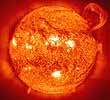 Just like personal computers on Earth, ESA's Solar and Heliospheric Observatory is getting a software upgrade of its own. After SOHO vanished in space in June 1998, engineers on two continents struggled for several weeks to regain control of the spacecraft.