|
 |
 |
 |
 |
 |
 |
 |
 |
 |

| . |  |
. |
Revealing Bizarre Deep-Sea Secrets
On Saturday, Aug. 7, Harbor Branch marine biologists and others will set out from Panama City, Fla. on an expedition called Operation Deep Scope to study the fantastic life forms of four alien landscapes in the deep reaches of the Gulf of Mexico. The team will be using the most advanced array of imaging tools ever deployed in the deep sea with the goal of revealing never before seen animals, behaviors, and phenomena. The expedition is funded by the National Oceanic and Atmospheric Administration's (NOAA) Office of Ocean Exploration, which was created to investigate the oceans for the purpose of discovery and the advancement of knowledge. NOAA is an agency of the U.S. Department of Commerce. Deep Scope will take place aboard Harbor Branch's Seward Johnson II research vessel and the Johnson-Sea-Link I submersible, which is capable of diving to 3,000 feet. Besides Harbor Branch scientists, the expedition will include researchers from Duke University; the University of Queensland, Australia; the Whitney Lab of the University of Florida; the University of Ulm, Germany; and Physical Science, Inc., in Andover, Mass. "This is the first time we've ever been able to assemble a team like this, with such a range of tools," says Dr. Edith Widder, expedition co-leader and head of Harbor Branch's Biophotonics Center. "Some of these areas have never been explored before and for many of the scientists, this expedition is a dream come true." The explorations will begin at Desoto Canyon where the team will study unexplored deepwater pinnacles about 120 miles south of Pensacola that support a diverse range of animals. Next they will visit a spectacular deepwater coral reef at a site known as Viosca Knoll. The third site is a community of chemosynthetic clams and worms that rely on methane-eating bacteria for nutrition. The worms are plentiful around the seeps and attract a number of predators such as fish and deep-sea sharks. Finally, the group will travel to a bizarre site 150 miles southeast of New Orleans known as the Brine Pool. There, salt deposits in the seafloor dissolve to create water so dense that it forms a shallow lake 2,100 feet below the ocean's surface. The expedition's main mission will be to discover new animals and new behaviors at these locations. To do that, the team will focus on observing and understanding the myriad uses of light in the dark reaches of the deep sea. More specifically, they will study the chemical-based bioluminescent light most deep-sea animals produce as well as fluorescent light, also given off by many marine animals. Other tasks will include measuring the amount and types of light found in the deep sea, as well as how the eyes of deep-sea animals allow them to see the faint light found in their dark home. Scientists are confident that the deep sea still holds numerous secrets, such as the identities of creatures that have so far eluded attempts to see and study them because of severe limitations with conventional techniques. Submersibles and remotely operated vehicles can scare away most mobile life with their bright lights, loud noises, and strong electrical fields, while nets allow countless animals to swim away unseen and shred slower, softer animals beyond recognition. "We're absolutely certain that we're still missing a great deal," says Dr. Widder, though conventional tools are important and have revealed much. For this mission, the team will be using tools that avoid some conventional pitfalls. One key instrument will be the Eye-in-the-Sea, which was designed by Dr. Widder. This unique camera system will be deployed on the seafloor using the submersible and left for 24-hour or longer intervals to film animals and activities using very low levels of infrared light that deep-sea animals cannot see. This will allow the camera to capture natural behaviors and quite possibly footage of animals that have evaded scientists using other tools. The system can be triggered to begin recording at programmed intervals to record animals attracted to bait or to an artificial lure designed to mimic the light given off by a common deep-sea jellyfish. Dr. Tammy Frank, the expedition's other co-leader and head of Harbor Branch's Visual Ecology Department, will use the submersible to deploy light-tight traps of her own design in hopes of bringing animals to the surface without damaging their eyes, as has typically been the case with past research. Eyes adapted to low light in the deep sea can be destroyed even by the relatively dim lights of a ship at night. The traps are baited then left open on the seafloor. After a period of time, the doors close automatically capturing inside the animals that have come to feed. Traps are then retrieved and unloaded in a darkroom where Dr. Frank and colleagues can study how their visual systems respond to light. The overall goal will be to learn what these animals are able to see under conditions where humans can see absolutely nothing. Answering such questions will not only help the team better understand the importance and functions of the small amounts of light found in the dark world of the deep sea, but may also lead to the discovery of new ways to increase the sensitivity of various man-made detectors. Dr. Charles Mazel from Physical Sciences, will be exploring fluorescence given off by deep -sea animals. Fluorescence occurs when an animal or object absorbs light of one color and then reemits light of, or glows, another color. In the ocean, detecting fluorescence can allow scientists to spot animals that would otherwise be too effectively camouflaged to see. Fluorescence is also important because the proteins that allow animals to fluoresce are used in genetic research and new fluorescent animals may contain proteins that offer novel benefits in such work. Dr. Mazel will use powerful lights mounted on the front of the submersible to illuminate animals whose fluorescence will then be captured on the sub's video camera using a filter that blocks non-fluorescent light reflected back. The filter can also be removed using the sub's robotic arm to allow filming of non-fluorescent views for comparison. To gain yet another new view of the deep, Dr. Justin Marshall from the University of Queensland, and colleagues, will be using polarized filters on the submersible video camera. Just as polarized sunglasses offer boaters a clearer view into the water by blocking out glare, polarized filters in the deep will allow scientists to see animals that hide from their predators - and normal cameras - using camouflage that exploits the properties of light polarization. "There's just no telling what we'll be able to find using these new techniques," says Dr. Widder, "and that's the best part of exploration � discovering something totally new and unexpected. It just doesn't get any better than that." Related Links Harbor Branch Oceanographic NOAA Ocean Explorer SpaceDaily Search SpaceDaily Subscribe To SpaceDaily Express  World's Smallest Autonomous Submarine
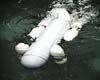 Canberra (SPX) Aug 05, 2004
A new era of oceanic discovery, with potential applications ranging from shipwreck recovery, to mineral exploration, to search and rescue missions may be possible with the development of the world's smallest autonomous underwater vehicle at The Australian National University.
|
|
| |||||||||
| The content herein, unless otherwise known to be public domain, are Copyright 1995-2016 - Space Media Network. All websites are published in Australia and are solely subject to Australian law and governed by Fair Use principals for news reporting and research purposes. AFP, UPI and IANS news wire stories are copyright Agence France-Presse, United Press International and Indo-Asia News Service. ESA news reports are copyright European Space Agency. All NASA sourced material is public domain. Additional copyrights may apply in whole or part to other bona fide parties. Advertising does not imply endorsement, agreement or approval of any opinions, statements or information provided by Space Media Network on any Web page published or hosted by Space Media Network. Privacy Statement All images and articles appearing on Space Media Network have been edited or digitally altered in some way. Any requests to remove copyright material will be acted upon in a timely and appropriate manner. Any attempt to extort money from Space Media Network will be ignored and reported to Australian Law Enforcement Agencies as a potential case of financial fraud involving the use of a telephonic carriage device or postal service. |