|
 |
 |
 |
 |
 |
 |
 |
 |
 |

| . |  |
. |
Brightest Explosion Ever Observed Overwhelms Telescopes
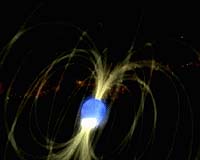
Scientists have detected a flash of light from across the Galaxy so powerful that it bounced off the Moon and lit up the Earth's upper atmosphere. This "giant flare" was the brightest explosion ever detected from beyond the Solar System. For over a tenth of a second the remarkable flare was actually brighter than a full moon. NASA and European satellites and ground-based telescopes around the world detected the giant flare on 27 December 2004. Scientists from twenty institutes joined the observations. Two science teams report about this unprecedented event in a forthcoming issue of Nature. The light detected from the giant flare was far brighter in gamma rays than visible light or X-rays. It was probably created by an unprecedented eruption on the surface of an exotic neutron star which is classed both as an ultra-magnetic magnetar and as a soft gamma repeater (SGR). The designation of the neutron star that erupted is SGR 1806-20, about 50,000 light years from Earth in the constellation Sagittarius. A number of important questions arise from this discovery:
British astronomers have focused on studying the radio emission from the event, which was produced as the explosion ploughed into the surrounding matter at about 100,000 km per second, heating particles to extraordinary energies. Dr. Rob Fender of Southampton University is a co-author on a Nature paper describing the radio observations. "This is a once-in-a-lifetime event. We have observed an object only 20 kilometres across, on the other side of our Galaxy, releasing more energy in a tenth of a second than the Sun emits in 100,000 years," said Fender. "The next biggest flare ever seen from any soft gamma repeater was peanuts compared to this incredible December 27 event," said Dr. Bryan Gaensler of the Harvard-Smithsonian Center for Astrophysics, lead author on the Nature paper. "Had this happened within 10 light years of us, it would have severely damaged our atmosphere and possibly have triggered a mass extinction. Fortunately there are no magnetars anywhere near us." "These neutron stars have magnetic fields hundreds of times more powerful than any other objects in the universe. We may be seeing a massive release of magnetic energy during a 'starquake' on the surface of the object," added Dr.Maura McLaughlin of the University of Manchester, also a co-author on the Nature paper. Radio observations of the neutron star continue around the world, including the UK's Multi-Element Radio-Linked Interferometer Network (MERLIN) and the Joint Institute for VLBI in Europe.
University of Southampton SpaceDaily Search SpaceDaily Subscribe To SpaceDaily Express  Light Continues To Echo Three Years After Stellar Outburst
 Washington DC (SPX) Feb 07, 2005
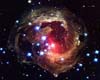
The illumination of interstellar dust comes from the red supergiant star at the middle of the image, which gave off a pulse of light three years ago, somewhat similar to setting off a flashbulb in a darkened room. The dust surrounding V838 Mon may have been ejected from the star during a previous explosion, similar to the 2002 event.
|
|
| |||||||||
| The content herein, unless otherwise known to be public domain, are Copyright 1995-2016 - Space Media Network. All websites are published in Australia and are solely subject to Australian law and governed by Fair Use principals for news reporting and research purposes. AFP, UPI and IANS news wire stories are copyright Agence France-Presse, United Press International and Indo-Asia News Service. ESA news reports are copyright European Space Agency. All NASA sourced material is public domain. Additional copyrights may apply in whole or part to other bona fide parties. Advertising does not imply endorsement, agreement or approval of any opinions, statements or information provided by Space Media Network on any Web page published or hosted by Space Media Network. Privacy Statement All images and articles appearing on Space Media Network have been edited or digitally altered in some way. Any requests to remove copyright material will be acted upon in a timely and appropriate manner. Any attempt to extort money from Space Media Network will be ignored and reported to Australian Law Enforcement Agencies as a potential case of financial fraud involving the use of a telephonic carriage device or postal service. |