
 |
 |
 |
 |
 |
 |
 |
 |
 |
 |

| . |  |
. |
German Dust Analyzer Closes In On Comet Wild-2 For Friday Flyby
On January 2nd at 19.20 UTC NASA's Stardust spacecraft will finally reach its target. After a journey of nearly 5 years through the solar system, the spacecraft will encounter the comet Wild 2. As one of only two fully scientific instruments, the spacecraft carries the German dust analyzer CIDA, built by the Schwetzingen-based company von Hoerner & Sulger. Stardust's task for this day is to collect and analyse the comet's dust as the probe performs a daring flyby past the comet's nucleus and its tail. Then, for the first time ever, the spacecraft will return to Earth carrying a selection of dust samples for scientists to investigate in their laboratories. The capsule containing the precious space dust is expected to arrive back on earth on the 15th January 2006, landing in the U.S. state of Utah. However, the dust particles and complex organic molecules from the comet nucleus are extremely fragile and are at some risk of being damaged during their capture by the spacecraft: Stardust passes the comet at a high velocity of 6 km/s. Therefore from the outset NASA wanted to have a proven instrument on the spacecraft, which is capable of providing immediate feedback and analysis of the cometary dust which is being collected. The choice was easy: CIDA, the latest version of a family of dust analyzers built by von Hoerner & Sulger, Schwetzingen. These instruments had already taken part in the "Halley Armada" in 1986, when three such instruments were used to place Halley's Comet under the magnifying glass leading to many important and significant discoveries. Once again the engineers from von Hoerner & Sulger with the lead scientist Dr. Jochen Kissel of the Max Planck Institute for Aeronomy in Katlenburg-Lindau, Germany, were selected for this NASA mission, with funding provided by the German federal government. Stardust is the first mission with the major focus on the dusty environment of a comet. As a secondary objective it will also collect the space dust which passes through our solar system. This interstellar dust and the dust found around the comet are closely related to each other and promise to provide crucial insight into the formation of our solar system and perhaps even the origin of life on planet Earth. Whilst the encounter with Wild 2 will last a mere moment relative to the duration of the mission, CIDA - the Cometary and Interstellar Dust Analyzer - will collect thousands of particles. The full analysis of the flood of data will take many months. All the staff at von Hoerner & Sulger GmbH are delighted to have made a major contribution to one of the most exciting space projects of our time. Related Links Details, Captions, Images and more of CIDA SpaceDaily Search SpaceDaily Subscribe To SpaceDaily Express  Chicago To Bump Through Comet
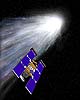 Chicago - Dec 28, 2003
A University of Chicago instrument will be riding shotgun on NASA's Stardust comet sampler which is set to fly by comet Wild-2 January 2, 2004. During the flyby Stardust will be blasted with a hail of dust particles traveling at over six kilometers per second as the spacecraft approaches to within 150 kilometers (93 miles) of Comet Wild-2 (pronounced "Vilt"-2) in 2004.
|
|
| |||||||||
| The content herein, unless otherwise known to be public domain, are Copyright 1995-2016 - Space Media Network. All websites are published in Australia and are solely subject to Australian law and governed by Fair Use principals for news reporting and research purposes. AFP, UPI and IANS news wire stories are copyright Agence France-Presse, United Press International and Indo-Asia News Service. ESA news reports are copyright European Space Agency. All NASA sourced material is public domain. Additional copyrights may apply in whole or part to other bona fide parties. Advertising does not imply endorsement, agreement or approval of any opinions, statements or information provided by Space Media Network on any Web page published or hosted by Space Media Network. Privacy Statement All images and articles appearing on Space Media Network have been edited or digitally altered in some way. Any requests to remove copyright material will be acted upon in a timely and appropriate manner. Any attempt to extort money from Space Media Network will be ignored and reported to Australian Law Enforcement Agencies as a potential case of financial fraud involving the use of a telephonic carriage device or postal service. |

