|
 |
 |
 |
 |
 |
 |
 |
 |
 |

| . |  |
. |
Stardust On Course For Comet Flyby
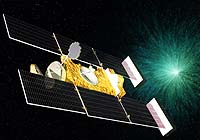
198 days before its historic rendezvous with a comet, NASA's Stardust spacecraft successfully completed the mission's third deep space maneuver. This critical maneuver modified the spacecraft's trajectory, placing it on a path to encounter and collect dust samples from comet Wild 2 in January 2004. At 2100 Universal Time (2:00 p.m. Pacific Time), Wed., June 18, Stardust fired its eight, 4.4 newton (1 pound) thrusters for a grand total of 1456 seconds, changing the comet sampler's speed by 34.4 meters per second (about 77 miles per hour). This burn, the second in two days, completed the almost seven-year-long mission's third deep space maneuver. The June 18 burn required 6.08 kilograms (13.4 pounds) of hydrazine monopropellant to complete. At launch, the spacecraft carried 85 kilograms (187 pounds) of hydrazine propellant. "It was a textbook maneuver," said Robert Ryan, Stardust's mission manager at NASA's Jet Propulsion Laboratory, Pasadena, Calif. "This was the last big burn we will have prior to our encounter with Wild 2, and it looks very accurate. After sifting through all the post-burn data I expect we will find ourselves right on the money." Stardust has traveled over 2.9 billion kilometers (1.8 billion miles) since its February 7, 1999 launch. At present, it is hurtling through the cosmos at 124,300 kilometers per hour (77,200 miles per hour). In January 2004, Stardust will fly through the halo of dust that surrounds the nucleus of comet Wild 2. The spacecraft will return to Earth in January 2006 to make a soft landing at the U.S. Air Force Utah Test and Training Range. Its sample return capsule, holding microscopic particles of comet and interstellar dust, will be taken to the planetary material curatorial facility at NASA's Johnson Space Center, Houston, Texas, where the samples will be carefully stored and examined. Stardust's cometary and interstellar dust samples will help provide answers to fundamental questions about the origins of the solar system, and is part of NASA's Discovery Program of low-cost, highly focused science missions. Related Links STARDUST at JPL SpaceDaily Search SpaceDaily Subscribe To SpaceDaily Express  Stardust Powers Up While It's Hot
 Pasadena - May 07, 2003
There were two periods of communications with the Stardust spacecraft in the past week. Telemetry relayed from the spacecraft indicates it is healthy and all subsystems continue to operate normally.
|
|
| |||||||||
| The content herein, unless otherwise known to be public domain, are Copyright 1995-2016 - Space Media Network. All websites are published in Australia and are solely subject to Australian law and governed by Fair Use principals for news reporting and research purposes. AFP, UPI and IANS news wire stories are copyright Agence France-Presse, United Press International and Indo-Asia News Service. ESA news reports are copyright European Space Agency. All NASA sourced material is public domain. Additional copyrights may apply in whole or part to other bona fide parties. Advertising does not imply endorsement, agreement or approval of any opinions, statements or information provided by Space Media Network on any Web page published or hosted by Space Media Network. Privacy Statement All images and articles appearing on Space Media Network have been edited or digitally altered in some way. Any requests to remove copyright material will be acted upon in a timely and appropriate manner. Any attempt to extort money from Space Media Network will be ignored and reported to Australian Law Enforcement Agencies as a potential case of financial fraud involving the use of a telephonic carriage device or postal service. |