|
 |
 |
 |
 |
 |
 |
 |
 |
 |

| . |  |
. |
Stardust To PassBy 5535 Annefrank
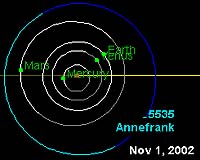
Stardust will take advantage of flying near a small asteroid next month to test many procedures the spacecraft will use 14 months later during its encounter with its primary science target, comet Wild-2. Stardust will pass within about 3,000 kilometers (about 1,900 miles) of asteroid Annefrank at 04:50 Nov. 2, Universal Time (8:50 p.m. Nov. 1, Pacific Standard Time). The spacecraft will automatically image Annefrank using camera tracking of the mountain-sized rock as it speeds by at 7 kilometers (4 miles) per second. "This is an engineering test," said Thomas Duxbury, project manager for Stardust at NASA's Jet Propulsion Laboratory, Pasadena, Calif. "We have no science goals or science expectations at Annefrank. It's an opportunity to try key procedures for the first time before we get to comet Wild-2. We may identify problems that we can address before we reach our primary target." Annefrank is about 4 kilometers (2.5 miles) across. Given the flyby distance, that's too small for a picture that would show any surface detail, said JPL's Ray Newburn, leader of the imaging-science team. Also, the angle of the encounter relative to the Sun will give Stardust a view in which only a thin crescent of the asteroid will be sunlit during approach, providing an additional challenge for the optical-navigation system to recognize it as a guiding light. Aerogel dust collectors that will gather comet dust from Wild-2 will stay open for the asteroid flyby. The Max Planck Institute dust analyzer and the University of Chicago dust flux monitor also will be operating. However, no dust from the asteroid is anticipated at the distance the spacecraft will pass. "This will be our most challenging event since launch," said JPL's Robert Ryan, Stardust mission manager. "Our spacecraft team at Lockheed Martin is testing everything in the spacecraft simulation laboratory before we send the commands up to the spacecraft." Chen-wan Yen, Stardust mission design manager at JPL, identified the opportunity for a flyby of Annefrank during the spacecraft's four-year cruise toward Wild-2. NASA approved the Annefrank test run this month, at no added cost. The asteroid was discovered in 1942 and later named in honor of Anne Frank, author of an inspiring diary of the two years before she was taken to a Nazi concentration camp. Stardust will bring samples of comet dust back to Earth in 2006 to help answer fundamental questions about the origins of the solar system. The mission's principal investigator is Dr. Donald Brownlee, professor of astronomy at the University of Washington, Seattle. Lockheed Martin Astronautics, Denver, Colo., built and operates the Stardust spacecraft. Related Links Stardust Asteroid 5535 Annefrank SpaceDaily Search SpaceDaily Subscribe To SpaceDaily Express  Asteroid Flyby Of Earth August 18
 Huntsville - Jul 31, 2002
A big space rock will soon come so close to Earth that sky watchers can see it through binoculars. But relax, there's no danger of a collision, but it will be close enough to see through binoculars: a big space rock, not far from Earth.
|
|
| |||||||||
| The content herein, unless otherwise known to be public domain, are Copyright 1995-2016 - Space Media Network. All websites are published in Australia and are solely subject to Australian law and governed by Fair Use principals for news reporting and research purposes. AFP, UPI and IANS news wire stories are copyright Agence France-Presse, United Press International and Indo-Asia News Service. ESA news reports are copyright European Space Agency. All NASA sourced material is public domain. Additional copyrights may apply in whole or part to other bona fide parties. Advertising does not imply endorsement, agreement or approval of any opinions, statements or information provided by Space Media Network on any Web page published or hosted by Space Media Network. Privacy Statement All images and articles appearing on Space Media Network have been edited or digitally altered in some way. Any requests to remove copyright material will be acted upon in a timely and appropriate manner. Any attempt to extort money from Space Media Network will be ignored and reported to Australian Law Enforcement Agencies as a potential case of financial fraud involving the use of a telephonic carriage device or postal service. |