|
 |
 |
 |
 |
 |
 |
 |
 |
 |

| . |  |
. |
Mockup Provides Early Glimpse Of New Space Exploration Vehicle
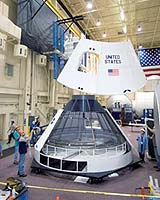
As NASA's next generation spacecraft matures, engineers will document its design with today's electronic equivalent to the blueprint. But diagrams, three-dimensional or not, only go so far in helping engineers understand what layouts best suit the job at hand and the humans involved. That's why Johnson Space Center in Houston has started building a full-sized mockup of the new craft's cockpit in its Space Vehicle Mockup Facility. The new spaceship -- known as the Crew Exploration Vehicle -- is the key to making NASA's Vision for Space Exploration a reality. A quick glance at the mockup reveals the resemblance to the original Apollo crew capsule. But the new capsule will be three times larger and is designed to carry four astronauts to and from the Moon, support up to six crewmembers on future missions to Mars and deliver crew and supplies to the International Space Station. Inside, the mockup remains largely unfinished. A temporary floor foreshadows the location for launch and entry seating, and a large hatch dominates the top of the cone. The hatch is wide enough for a human to pass through easily and will be the point where the crew capsule will dock with a lunar lander for the first trip back to the Moon, currently targeted for 2018. The mockup represents the first leg of a three-step design philosophy. In stage one, design teams discuss various theories over how best to utilize cockpit space and commit their ideas to paper. Then engineers use computer design programs to produce working 3-D models of the crew's space. While work continues on these stages, team members simultaneously use the mockup to experiment with physical relationships in a real-world environment. "You discover new things during each stage of the design process," said Jeff Fox, lead cockpit engineer on the spacecraft. "But your brain needs the input of physically standing inside the real volume of the interior space to get a true feeling of what should be the right layout." Workers are making changes to ensure the current model matches the inner measurements of the most recent design. Once that's finished, the team will start working on how to arrange seats and where to put the spacecraft's controls. The team is already working on plans to arrange cockpit seating in three-, four- and six-person configurations. In the early phases, simple foam-core boxes will serve as substitutes for real-world hardware such as computers and cargo. The stand-ins will gradually give way to more accurate versions of the real thing, helping the designers visualize what the computers can't show. As Fox puts it, "there's just no substitute for reality." Related Links SpaceDaily Search SpaceDaily Subscribe To SpaceDaily Express  SpaceDev Announces SpaceDev Dream Chaser Space Transport System
 Poway CA (SPX) Nov 17, 2005
SpaceDev announced Wednesday its concept for the SpaceDev Dream Chaser vehicle, a six-passenger human space transport system based on the ten-passenger HL-20 Personnel Launch System developed by NASA Langley.
|
|
| |||||||||
| The content herein, unless otherwise known to be public domain, are Copyright 1995-2016 - Space Media Network. All websites are published in Australia and are solely subject to Australian law and governed by Fair Use principals for news reporting and research purposes. AFP, UPI and IANS news wire stories are copyright Agence France-Presse, United Press International and Indo-Asia News Service. ESA news reports are copyright European Space Agency. All NASA sourced material is public domain. Additional copyrights may apply in whole or part to other bona fide parties. Advertising does not imply endorsement, agreement or approval of any opinions, statements or information provided by Space Media Network on any Web page published or hosted by Space Media Network. Privacy Statement All images and articles appearing on Space Media Network have been edited or digitally altered in some way. Any requests to remove copyright material will be acted upon in a timely and appropriate manner. Any attempt to extort money from Space Media Network will be ignored and reported to Australian Law Enforcement Agencies as a potential case of financial fraud involving the use of a telephonic carriage device or postal service. |