|
 |
 |
 |
 |
 |
 |
 |
 |
 |

| . |  |
. |
Tokyo Shortly To Decide On Participation In Russian Kliper Project
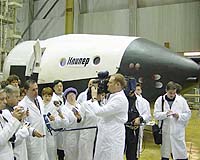
Tokyo intends to decide already this year on its participation in the Russian project to build a non-expendable manned spacecraft, which will be called Kliper. It is expected to replace the American shuttles that are now being used to fly crews and cargoes to the International Space Station, reports Itar-Tass. A special team has already been formed here to look into the problem. Kiioshi Higuchi, member of the Board of Directors of the Japanese National Aerospace Exploration Agency (JAXA), heads the team, the Kyodo Tsushin News Agency reported on Thursday. The European Space Agency, Ukraine, Belarus and Kazakhstan had previously evinced interest in their participation in the new Russian space project. In considering the problem, Tokyo is proceeding primarily from the fact that the United States is determined to discontinue all flights of its shuttles by 2010 and to concentrate its efforts on the preparation of expeditions to the Moon and Mars. The Kliper project will give Russia, the EU countries, and Japan a chance to make effective use of the International Space Station even without America's active participation. A Kliper spacecraft will be able to carry six people and to take to the ISS and bring back five hundred kilograms of cargoes. A rocket will be used to boost it into outer space. A Kliper will be able to fly autonomously for fifteen days running. Its non-expendable recovery capsule is designed for twenty-five flights. The spacecraft will have a service life of ten years. It is planned to launch the first Kliper into outer space in 2013. Related Links SpaceDaily Search SpaceDaily Subscribe To SpaceDaily Express  Northrop Grumman-Boeing Team Unveils Plans For Space Shuttle Successor
 Washington DC (SPX) Oct 13, 2005
The Northrop Grumman and Boeing CEV team today unveiled its plans to design and build NASA's proposed Crew Exploration Vehicle (CEV), a modular space system intended to carry humans to the International Space Station by 2012 and back to the moon by 2018.
|
|
| |||||||||
| The content herein, unless otherwise known to be public domain, are Copyright 1995-2016 - Space Media Network. All websites are published in Australia and are solely subject to Australian law and governed by Fair Use principals for news reporting and research purposes. AFP, UPI and IANS news wire stories are copyright Agence France-Presse, United Press International and Indo-Asia News Service. ESA news reports are copyright European Space Agency. All NASA sourced material is public domain. Additional copyrights may apply in whole or part to other bona fide parties. Advertising does not imply endorsement, agreement or approval of any opinions, statements or information provided by Space Media Network on any Web page published or hosted by Space Media Network. Privacy Statement All images and articles appearing on Space Media Network have been edited or digitally altered in some way. Any requests to remove copyright material will be acted upon in a timely and appropriate manner. Any attempt to extort money from Space Media Network will be ignored and reported to Australian Law Enforcement Agencies as a potential case of financial fraud involving the use of a telephonic carriage device or postal service. |