|
 |
 |
 |
 |
 |
 |
 |
 |
 |

| . |  |
. |
Impact Scare in 2030 Put To Rest
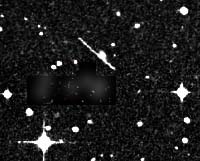
Near-Earth Object Program Office Pasadena - Nov. 4, 2000 On the afternoon of November 3, Carl Hergenrother of the Catalina Sky Survey (CSS) near Tucson, Arizona, obtained and made available additional observations of object 2000 SG344 from the CSS image archives. These pre-discovery observations significantly improved the certainty of the object's position in 2030 and effectively ruled out the chance of an Earth impact in that year. As explained in the earlier release from the International Astronomical Union (IAU), this was the most likely outcome of the continuing investigations. With the new data, we can say that the closest the object can approach the Earth in 2030 is 11 lunar distances on September 23. These results are in agreement with those of Andrea Milani at the University of Pisa, Italy. The earlier announcement of a possible Earth impact in 2030 made by the Technical Review Team of the IAU followed the recently established process for reviewing Torino Scale 1 impact predictions. In the first use of this procedure, the Team formed a consensus opinion and, following the IAU mandate, made their results public within 72 hours. While the new orbital calculations have ruled out the 2030 event, they have also increased the likelihood of encounters in years after 2030. For example, for the date September 16, 2071, current computations indicate roughly a 1 in 1000 chance of an Earth impact. However, these calculations assume that object 2000 SG344 is asteroidal in nature. There remains the significant possibility that this object is a spacecraft booster rocket from the Apollo era and studies are continuing to assess this possibility. Additional observations of the object will be possible in the coming months and these should further refine the calculations and conclusions. Related Links SpaceDaily Search SpaceDaily Subscribe To SpaceDaily Express  Near-Earth Objects An International Research Issue
 London - Oct 16, 2000
The hazard posed to humanity by cosmic impacts is international in character. While km-sized impactors would cause important, global perturbations to the Earth's biosphere and climate, those of somewhat smaller size could also have serious international consequences, affecting densely populated coastal areas in several countries.
|
|
| |||||||||
| The content herein, unless otherwise known to be public domain, are Copyright 1995-2016 - Space Media Network. All websites are published in Australia and are solely subject to Australian law and governed by Fair Use principals for news reporting and research purposes. AFP, UPI and IANS news wire stories are copyright Agence France-Presse, United Press International and Indo-Asia News Service. ESA news reports are copyright European Space Agency. All NASA sourced material is public domain. Additional copyrights may apply in whole or part to other bona fide parties. Advertising does not imply endorsement, agreement or approval of any opinions, statements or information provided by Space Media Network on any Web page published or hosted by Space Media Network. Privacy Statement All images and articles appearing on Space Media Network have been edited or digitally altered in some way. Any requests to remove copyright material will be acted upon in a timely and appropriate manner. Any attempt to extort money from Space Media Network will be ignored and reported to Australian Law Enforcement Agencies as a potential case of financial fraud involving the use of a telephonic carriage device or postal service. |