|
 |
 |
 |
 |
 |
 |
 |
 |
 |

| . |  |
. |
|
SOLAR WEATHER
Solar Storms Help Destroy The Ozone
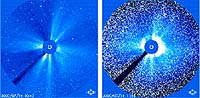
Solar storms that bombard earth's atmosphere with electrically charged particles contribute to the destruction of the upper-level ozone, scientists confirmed in Wednesday's issue of Geophysical Research Letters. NASA researchers used satellites to examine the impact on the northern hemisphere of solar explosions that sent positively-charged protons streaming to earth between July 14 to 16 2000, in what scientists called the third largest "solar proton event" in 30 years. Once they reached the upper atmosphere, the protons broke up nitrogen gas molecules, creating nitrogen oxides which can last for weeks to months and destroy up to nine percent of the ozone in the upper stratosphere, at 15 to 50 kilometers (10 to 30 miles) of altitude, the study said. "A lot of impacts on ozone are very subtle and can happen over long periods of time. But when these solar proton events occur you can see immediately a change in the atmosphere, so you have a clear cause and effect," said Charles Jackman of NASA's Goddard Space Flight Center Laboratory for Atmospheres, the lead author of the study. The solar protons also break the atmosphere's water vapor molecules into hydrogen oxides which can destroy up to 70 percent of the ozone in the middle mesosphere, located from 50 to 90 kilometers (30 to 55 miles) of altitude. The hydrogen oxides last only for the duration of the solar proton event, however. Only a small percent of the ozone is located in the mesosphere and upper stratosphere, while over 80 percent of the protective gas which maintains earth's temperature and shields its life from the sun's ultraviolet radiation is located in the middle and lower stratosphere, at 15 to 35 kilometers (10 to 20 kilometers). "If you look at the total atmospheric column, from your head on up to the top of the atmosphere, this solar proton event depleted less than one percent of the total ozone in the Northern Hemisphere," Jackman said. The ozone layer is also depleted by human industrial activity, especially emissions of human-produced compounds such as chlorofluorocarbons (CFCs) and halon gas. Related Links SOHO Missione Trace Mission SpaceDaily Search SpaceDaily Subscribe To SpaceDaily Express 
SOLAR WEATHER
EO Bird "Wind" Takes Flight Through The "Spigot" To Capture Rare Data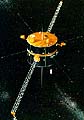 Berkeley - July 25, 2001
Through a combination of good luck and shrewd data analysis, researchers using NASA's Wind spacecraft have made rare direct observations of the mysterious process that allows the solar wind to connect to Earth's magnetic field (the magnetosphere).
|
|
| |||||||||
| The content herein, unless otherwise known to be public domain, are Copyright 1995-2016 - Space Media Network. All websites are published in Australia and are solely subject to Australian law and governed by Fair Use principals for news reporting and research purposes. AFP, UPI and IANS news wire stories are copyright Agence France-Presse, United Press International and Indo-Asia News Service. ESA news reports are copyright European Space Agency. All NASA sourced material is public domain. Additional copyrights may apply in whole or part to other bona fide parties. Advertising does not imply endorsement, agreement or approval of any opinions, statements or information provided by Space Media Network on any Web page published or hosted by Space Media Network. Privacy Statement All images and articles appearing on Space Media Network have been edited or digitally altered in some way. Any requests to remove copyright material will be acted upon in a timely and appropriate manner. Any attempt to extort money from Space Media Network will be ignored and reported to Australian Law Enforcement Agencies as a potential case of financial fraud involving the use of a telephonic carriage device or postal service. |