|
 |
 |
 |
 |
 |
 |
 |
 |
 |

| . |  |
. |
Solar Tadpoles Wave At Astrophysicists
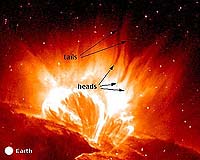
Researchers at the University of Warwick's Department of Physics have gained insight into the mysterious giant dark "tadpoles" that appear to swim towards the surface of the Sun during solar flares - enormous energy releases happening in the atmosphere of the Sun. The tadpoles - colossal physical structures with dark heads and attendant wiggly tails that seem to swim sunwards against tides of hot matter being thrown away from the Sun during flares - have puzzled astrophysicists for several years, as they are so unlike any other phenomena observed on the Sun. University of Warwick researchers Dr Valery Nakariakov and Dr Erwin Verwichte believe they have managed to understand the physics of this process. They analysed observations obtained with NASA's "Transition Region And Coronal Explorer" (TRACE) space mission and put forward the idea that the wiggles of the tadpoles' tails are huge waves - similar to the flying of flags in the wind - though, these solar wiggles are several times larger than the Earth. The scientists think that the waves are produced by a peculiar physical mechanism known as "negative energy waves", when waves suck energy from the medium they propagate through. The understanding of the wiggles allowed the researchers to conclude that the tadpoles themselves are not material features, but optical illusions, as the solar matter is not falling down but is being continuously thrown upwards. The apparently descending tadpole head marks the falling start point of the matter's upward acceleration This work has just been published this month as a Letter in Astronomy and Astrophysics. An animation of the tadpoles can be seen here. Related Links Dr Valery Nakariakov's homepage Dr Erwin Verwichte's homepage SpaceDaily Search SpaceDaily Subscribe To SpaceDaily Express  Lockheed Martin To Develop Sensor For Interstellar Boundary Explorer Mission
 Palo Alto CA (SPX) Feb 18, 2005
The Lockheed Martin Advanced Technology Center (ATC) will lead the development of the Interstellar Boundary Explorer (IBEX)-Lo sensor for the recently selected NASA Small Explorer mission.
|
|
| |||||||||
| The content herein, unless otherwise known to be public domain, are Copyright 1995-2016 - Space Media Network. All websites are published in Australia and are solely subject to Australian law and governed by Fair Use principals for news reporting and research purposes. AFP, UPI and IANS news wire stories are copyright Agence France-Presse, United Press International and Indo-Asia News Service. ESA news reports are copyright European Space Agency. All NASA sourced material is public domain. Additional copyrights may apply in whole or part to other bona fide parties. Advertising does not imply endorsement, agreement or approval of any opinions, statements or information provided by Space Media Network on any Web page published or hosted by Space Media Network. Privacy Statement All images and articles appearing on Space Media Network have been edited or digitally altered in some way. Any requests to remove copyright material will be acted upon in a timely and appropriate manner. Any attempt to extort money from Space Media Network will be ignored and reported to Australian Law Enforcement Agencies as a potential case of financial fraud involving the use of a telephonic carriage device or postal service. |