|
 |
 |
 |
 |
 |
 |
 |
 |
 |

| . |  |
. |
Atlantis Launch Delayed Until Thursday At Earliest
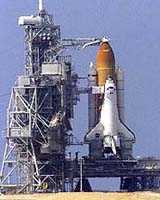
NASA, with a wary eye on the progress of Hurricane Lili, on Tuesday pushed back the launch of the space shuttle Atlantis from Wednesday to Thursday at the earliest. From the moment a shuttle blasts off from here, it is monitored by the NASA's Johnson Space Center in Houston, home to the space shuttle flight control center. And the storm, which is expected to pass within 260 kilometers (140 miles) of Houston, could interfere with the center's communications with the shuttle. Atlantis is the first shuttle scheduled for orbit since structural defects forced shutdown of the program last July. At that time, tiny cracks were found in all four shuttles along the metal fuel liners that help smooth the delivery of liquid hydrogen to the main engine turbo pumps. Launches were postponed until August, when NASA found cracks in the giant crawlers that transport the shuttles from their docks to the launch pad. Launches were postponed again to late September. "The launch has been delayed to no earlier than Thursday between 2:00 and 6:00 pm, due to weather concerns at the Johnson Space Center," said NASA spokesman Bruce Buckingham. The decision to suspend was made after a Tuesday afternoon meeting in which NASA officials viewed the likely consequences if Lili takes the forecasted path near Houston. Now a category two hurricane, Lili on Tuesday was blasting western Cuba with 160 kilometers an hour (100 mph) winds, the US National Weather Service said, probably gaining intensity as it churns out into the Gulf of Mexico. "One model sees the hurricane reaching Louisiana on Friday, but it could go further west, toward Houston," said George Diller, a NASA spokesman. However, he said, another model foresees the hurricane going further to the west, toward Houston. "There could be high winds," Diller added. "There may still be a situation where they may have to evacuate" the Houston space center, possibly even with a loss of power. A category two hurricane on the Saffir-Simpson scale has a 154.5-177 kph (96-110 mph) wind speed range. Earlier, NASA's shuttle programme manager Ron Dittemore underlined that Atlantis was otherwise in fine shape to launch. "Engineering and ground processing teams have done outstanding work in the past few months to ensure the readiness of Atlantis for a safe flight," he said. "Atlantis is in great shape and ready to fly." Atlantis' 11-day mission, with a team of six astronauts aboard, aims to install a 15-meter (45-foot) arm on the International Space Station (ISS), which will include part of its air conditioning system. Atlantis is due to return on October 13. The next flight to the space station will be by the shuttle Endeavor, with take-off scheduled for November 10 with a replacement crew aboard. This will be the 26th flight by Atlantis and the 15th mission as part of the ISS construction programme. National Aeronautics and Space Administration engineers have been working round the clock to ensure problems do not seriously hold up construction of the ISS, now under threat due to the financial woes of one of its main partners, Russia. The United States last week urged the Russian authorities to meet their commitment to the space station. All rights reserved. � 2002 Agence France-Presse. Sections of the information displayed on this page (dispatches, photographs, logos) are protected by intellectual property rights owned by Agence France-Presse. As a consequence, you may not copy, reproduce, modify, transmit, publish, display or in any way commercially exploit any of the content of this section without the prior written consent of Agence France-Presse. Related Links SpaceDaily Search SpaceDaily Subscribe To SpaceDaily Express  ISS To Get More Backbone In Long Delayed Mission
 Huntsville - Sep 30, 2002
Each part of the International Space Station is a handcrafted masterpiece of aerospace engineering. Some of the most important parts, however, will never fly in space. They are the "test articles" -- test parts that get pushed, pulled, shaken, blasted by loudspeakers and much more to ensure that the real hardware can stand up to the rigors of launch and years in space.
|
|
| |||||||||
| The content herein, unless otherwise known to be public domain, are Copyright 1995-2016 - Space Media Network. All websites are published in Australia and are solely subject to Australian law and governed by Fair Use principals for news reporting and research purposes. AFP, UPI and IANS news wire stories are copyright Agence France-Presse, United Press International and Indo-Asia News Service. ESA news reports are copyright European Space Agency. All NASA sourced material is public domain. Additional copyrights may apply in whole or part to other bona fide parties. Advertising does not imply endorsement, agreement or approval of any opinions, statements or information provided by Space Media Network on any Web page published or hosted by Space Media Network. Privacy Statement All images and articles appearing on Space Media Network have been edited or digitally altered in some way. Any requests to remove copyright material will be acted upon in a timely and appropriate manner. Any attempt to extort money from Space Media Network will be ignored and reported to Australian Law Enforcement Agencies as a potential case of financial fraud involving the use of a telephonic carriage device or postal service. |