|
 |
 |
 |
 |
 |
 |
 |
 |
 |

| . |  |
. |
SpaceX Announces The Falcon 9 Fully Reusable Heavy Lift Launch Vehicle
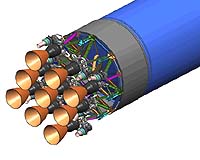
SpaceX has announced its new launch vehicle, the Falcon 9, an Evolved Expendable Launch Vehicle (EELV) class vehicle. With up to a 17 ft (5.2 m) diameter fairing, Falcon 9 is capable of launching approximately 21,000 lbs (9,500 kg) to Low Earth Orbit (LEO) in its medium configuration and 55,000 lbs (25,000 kg) to LEO in its heavy configuration, a lift capacity greater than any other launch vehicle. In the medium configuration, Falcon 9 is priced at $27 million per flight with a 12 ft (3.6 m) fairing and $35 million with a 17 ft fairing. Prices include all launch range and third party insurance costs, making Falcon 9 the most cost efficient vehicle in its class worldwide. SpaceX initially intended to follow its first vehicle development, Falcon 1, with the intermediate class Falcon 5 launch vehicle. However, in response to customer requirements for low cost enhanced launch capability, SpaceX accelerated development of an EELV-class vehicle, upgrading Falcon 5 to Falcon 9. SpaceX has sold Falcon 9 to a US government customer. SpaceX still plans to make Falcon 5 available in late 2007. Falcon 9 uses similar engines, electronics, guidance & control and separation systems to Falcon 1. However, in the case of Falcon 9 there are nine Merlin engines clustered together. Some examples of rockets that made effective use of clustering are the Saturn I manned rocket (eight thrust chambers) of the Apollo Program and the Soyuz manned rocket (thirty-two thrust chambers) currently used to service the International Space Station. Clustering provides the ability to lose multiple engines during flight and still complete the mission, resulting in a higher level of propulsion reliability. A recent study performed by the Futron Corporation, concluded that Falcon 5 was superior in design reliability to other vehicles in its class, due to engine redundancy. Falcon 9, by extension, has even higher reliability with increased propulsion redundancy. Falcon 5 and Falcon 9 will be the world�s first launch vehicles where all stages are designed for reuse. The Falcon 1 has a reusable first stage, but an expendable upper stage. Reuse is not factored into launch prices. When the economics of stage recovery and checkout are fully understood, SpaceX will make further reductions in launch prices. SpaceX has launch sites at Vandenberg Air Force Base, Cape Canaveral Air Force Station and the Marshall Islands, allowing for direct launch into any orbital inclination. With its launch complex in the Marshall Islands, SpaceX is the only US heavy launch provider with a launch site close to the equator, providing an advantage for equatorial satellite launch. Related Links SpaceX SpaceDaily Search SpaceDaily Subscribe To SpaceDaily Express  XCOR Aerospace Completes Successful Development Of Methane Rocket Engine
 Mojave CA (SPX) Aug 31, 2005
XCOR Aerospace announced Monday that it has successfully completed its first series of tests on a 50 pound thrust rocket engine fueled by methane and liquid oxygen.
|
|
| |||||||||
| The content herein, unless otherwise known to be public domain, are Copyright 1995-2016 - Space Media Network. All websites are published in Australia and are solely subject to Australian law and governed by Fair Use principals for news reporting and research purposes. AFP, UPI and IANS news wire stories are copyright Agence France-Presse, United Press International and Indo-Asia News Service. ESA news reports are copyright European Space Agency. All NASA sourced material is public domain. Additional copyrights may apply in whole or part to other bona fide parties. Advertising does not imply endorsement, agreement or approval of any opinions, statements or information provided by Space Media Network on any Web page published or hosted by Space Media Network. Privacy Statement All images and articles appearing on Space Media Network have been edited or digitally altered in some way. Any requests to remove copyright material will be acted upon in a timely and appropriate manner. Any attempt to extort money from Space Media Network will be ignored and reported to Australian Law Enforcement Agencies as a potential case of financial fraud involving the use of a telephonic carriage device or postal service. |