|
 |
 |
 |
 |
 |
 |
 |
 |
 |

| . |  |
. |
Peterson Space Battlelab To Demonstrate Near Space Maneuvering Vehicle
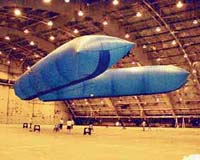
Members of the Air Force Space Battlelab will conduct a Phase I demonstration flight of the V-Airship, a Near Space Maneuvering Vehicle, in late February at the new Pecos County/West Texas Spaceport in Ft. Stockton, Texas. Battlelab members from Schriever Air Force Base near Colorado Springs, Colo., hope to demonstrate the unique capabilities of the V-Airship by ascending the craft to 100,000 feet Mean Sea Level using a 10-pound command and control package, navigating between two predetermined points, loitering for 5 minutes, and then safely returning the craft to the spaceport. The battlelab also hopes to validate the operation of an autonomous onboard GPS navigation package and the operation of two motors driving carbon fiber propellers. Since working with the V-Airship, the Battlelab envisions the possibility of exploiting a previously untapped portion of the atmosphere known as "near-space" which extends from 65,000 feet to 100 kilometers. In addition, the Battlelab is currently studying a near-space enabling concept that may include a variety of vehicles and platforms to exploit the near space regime. If this inaugural demonstration flight is successful, the Space Battlelab will investigate funding a Phase II program to build a vehicle that will ascend to over 100,000 feet with a 100-pound payload. Pending a funding decision, this vehicle could fly in late 2004 or early 2005. The Army, Navy and several Unified Commands have expressed interest in the program, believing NSMVs offer a quick-launch intelligence, surveillance and reconnaissance satellite capability. Related Links JP Aerospace Air Force Research Lab SpaceDaily Search SpaceDaily Subscribe To SpaceDaily Express  X-43A Flight Delayed
 Edwards AFB - Feb 18, 2004
The flight of NASA's X-43A has been postponed, due to an incident with the rudder actuator on the booster. On Feb 11, during setup at Orbital Sciences Corporation for testing of the rudder and its actuator, an anomaly caused the actuator to go hard over and hit its mechanical stop, exceeding the torque to which the units were qualified.
|
|
| |||||||||
| The content herein, unless otherwise known to be public domain, are Copyright 1995-2016 - Space Media Network. All websites are published in Australia and are solely subject to Australian law and governed by Fair Use principals for news reporting and research purposes. AFP, UPI and IANS news wire stories are copyright Agence France-Presse, United Press International and Indo-Asia News Service. ESA news reports are copyright European Space Agency. All NASA sourced material is public domain. Additional copyrights may apply in whole or part to other bona fide parties. Advertising does not imply endorsement, agreement or approval of any opinions, statements or information provided by Space Media Network on any Web page published or hosted by Space Media Network. Privacy Statement All images and articles appearing on Space Media Network have been edited or digitally altered in some way. Any requests to remove copyright material will be acted upon in a timely and appropriate manner. Any attempt to extort money from Space Media Network will be ignored and reported to Australian Law Enforcement Agencies as a potential case of financial fraud involving the use of a telephonic carriage device or postal service. |