|
 |
 |
 |
 |
 |
 |
 |
 |
 |

| . |  |
. |
Futron Reviews Our Orbital ASCENT
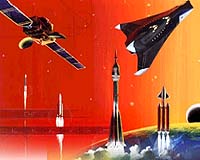
Futron has recently completed a groundbreaking study of existing and emerging space markets. The study, commissioned by NASA's Marshall Space Flight Center (MSFC) as part of the Space Launch Initiative, was dubbed the ASCENT Study, which stands for Analysis of Space Concepts Enabled by New Transportation. The "new transportation" in question at the onset of the study was the Space Shuttle follow-on, then known as the 2 nd Generation Reusable Launch Vehicle (2 nd Gen RLV). NASA envisioned that the 2 nd Gen RLV would be commercially owned and operated. For this to be accomplished, a business case would need to be made regarding the viability of a 2 nd Gen RLV. The key aspects of a business case for any RLV include the available launch market for the vehicle (government and commercial) and the flight rate it could achieve. The ASCENT Study was initiated specifically to address the business case for a 2 nd Gen RLV. In order to accurately assess the potential market and flight rate for an RLV, the underlying demand for launches must be quantified. As anyone who follows the launch industry knows, accurate forecasts of existing space markets (e.g., telecommunications, surveillance, and remote sensing) are hard to find. Furthermore, current data and forecasts on nascent and future space markets (e.g., space tourism, space manufacturing, and space solar power) are practically non-existent. Determining the underlying demand for space-related applications and translating that demand into global launch forecasts were the challenges Futron met in the ASCENT Study. The study forecasted the size of government and commercial space markets for the next 20 years, determined sensitivities to the forecasts, and assessed the business opportunities for current and future launch systems. Futron's goal was to establish the "definitive word" on the various space markets, their viability, maturity, size, and elasticity.
Futron applied several principles in the execution of the ASCENT Study, including the following:
This pragmatic approach brought a cold blast ofrealism to past studies and forecasts. We now have a much better understanding of what is possible, what is not, and where we should focus our attention. Thus, even though NASA has redefined its space transportation strategy to focus on an Orbital Space Plane (OSP), the ASCENT Study uncovered the answers to some unanswered questions. This White Paper highlights the 10 most interesting findings. The complete report is available here as a PDF file Related Links Futon SpaceDaily Search SpaceDaily Subscribe To SpaceDaily Express  Compression Experiments In World's Largest Pulse Power Machine
 Seattle - Apr 08, 2003
Andrews Space & Technology (AS&T) successfully demonstrated the fundamental operating principles of a propulsion system that could dramatically affect interplanetary space travel, shortening round trips to Mars from two years to six months and making future trips to Jupiter and back a two-year affair.
|
|
| |||||||||
| The content herein, unless otherwise known to be public domain, are Copyright 1995-2016 - Space Media Network. All websites are published in Australia and are solely subject to Australian law and governed by Fair Use principals for news reporting and research purposes. AFP, UPI and IANS news wire stories are copyright Agence France-Presse, United Press International and Indo-Asia News Service. ESA news reports are copyright European Space Agency. All NASA sourced material is public domain. Additional copyrights may apply in whole or part to other bona fide parties. Advertising does not imply endorsement, agreement or approval of any opinions, statements or information provided by Space Media Network on any Web page published or hosted by Space Media Network. Privacy Statement All images and articles appearing on Space Media Network have been edited or digitally altered in some way. Any requests to remove copyright material will be acted upon in a timely and appropriate manner. Any attempt to extort money from Space Media Network will be ignored and reported to Australian Law Enforcement Agencies as a potential case of financial fraud involving the use of a telephonic carriage device or postal service. |