|
 |
 |
 |
 |
 |
 |
 |
 |
 |

| . |  |
. |
The Rise Of The Body Bots
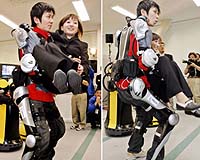
Today, in Japan and the United States, engineers are finally putting some practical exoskeletons through their paces outside of laboratories. According to an article in the October issue of IEEE Spectrum, the very first commercially available exoskeleton, scheduled to hit the market in Japan in November, is designed to help elderly and disabled people walk and carry things. Built by Cyberdyne in Tsukuba, Japan, the exoskeleton, called HAL-5, will cost about 1.5 million yen (around US $13 800). Meanwhile, in the United States, the most advanced exoskeleton projects are at the University of California, Berkeley, and at Sarcos Research Corp., in Salt Lake City. Both are funded under a $40 million, five-year program begun by the Defense Advanced Research Projects Agency (DARPA) in 2001. According to the Spectrum article, during the past several months each group has been field-testing a second-generation exoskeleton that is a huge improvement over its predecessor. At long last, exoskeletons, once the stuff of science fiction, are on the verge of proving themselves in military and civilian applications. This new generation of anthropomorphic, untethered, and self-powered exoskeletons is marrying humans' decision-making capabilities wwith machines' dexterity and brute force. They've got the brains to control the brawn. Related Links SpaceDaily Search SpaceDaily Subscribe To SpaceDaily Express  Foster-Miller Awarded $96 Million Contract For Additional TALON Robots
 Waltham MA (SPX) Sep 20, 2005
Foster-Miller has announced that it has received its largest US military order to date for ground robots. The multi-year contract increased from $27.5 million for 250 robots to $124 million for up to 1200 TALON Explosive Ordnance Disposal (EOD) robots.
|
|
| |||||||||
| The content herein, unless otherwise known to be public domain, are Copyright 1995-2016 - Space Media Network. All websites are published in Australia and are solely subject to Australian law and governed by Fair Use principals for news reporting and research purposes. AFP, UPI and IANS news wire stories are copyright Agence France-Presse, United Press International and Indo-Asia News Service. ESA news reports are copyright European Space Agency. All NASA sourced material is public domain. Additional copyrights may apply in whole or part to other bona fide parties. Advertising does not imply endorsement, agreement or approval of any opinions, statements or information provided by Space Media Network on any Web page published or hosted by Space Media Network. Privacy Statement All images and articles appearing on Space Media Network have been edited or digitally altered in some way. Any requests to remove copyright material will be acted upon in a timely and appropriate manner. Any attempt to extort money from Space Media Network will be ignored and reported to Australian Law Enforcement Agencies as a potential case of financial fraud involving the use of a telephonic carriage device or postal service. |