|
 |
 |
 |
 |
 |
 |
 |
 |
 |

| . |  |
. |
NASA's DART Autonomous Rendezvous Test Mission Fails
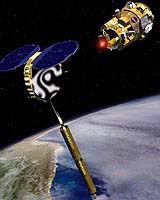
The Demonstration of Autonomous Rendezvous Technology (DART) spacecraft that was successfully launched Friday at 10:25 a.m. PDT from Vandenberg Air Force Base, Calif., experienced an on orbit anomaly late Friday. After a successful rendezvous, acquisition of the target spacecraft, and approach to within approximately 300 feet, DART placed itself in the retirement phase before completing all planned proximity operations, ending the mission prematurely. NASA is convening a mishap investigation board to determine the reason for the DART spacecraft anomaly. A teleconference with DART project managers was scheduled for 11 a.m. PDT. The DART spacecraft was a flight experiment attempting to establish autonomous rendezvous capabilities for the U.S. space program. While previous rendezvous and docking efforts have been piloted by astronauts, the DART spacecraft completed the rendezvous and acquisition with no human intervention, relying on a variety of sensors and analyses to complete these functions.
Updates DART, short for Demonstration of Autonomous Rendezvous Technology, was launched Friday from Vandenberg Air Force Base in California with a boost from a Pegasus rocket but suffered a glitch in orbit that forced NASA to scrap the mission. DART is designed to find another spacecraft in space, rendezvous and dock, without human guidance. The space agency wants to test the craft as a cost-cutting measure in President George W. Bush's initiative to return humans to the moon and pursue manned exploration of Mars. "After a successful rendezvous, acquisition of the target spacecraft and approach to within approximately 300 feet (91 meters), DART placed itself in the retirement phase before completing all planned proximity operations, ending the mission prematurely," NASA said in a statement Saturday. NASA said it was "convening a mishap investigation board to determine the reason for the DART spacecraft anomaly." All rights reserved. � 2004 Agence France-Presse. Sections of the information displayed on this page (dispatches, photographs, logos) are protected by intellectual property rights owned by Agence France-Presse. As a consequence, you may not copy, reproduce, modify, transmit, publish, display or in any way commercially exploit any of the content of this section without the prior written consent of Agence France-Presse. Related Links SpaceDaily Search SpaceDaily Subscribe To SpaceDaily Express 
|
|
| |||||||||
| The content herein, unless otherwise known to be public domain, are Copyright 1995-2016 - Space Media Network. All websites are published in Australia and are solely subject to Australian law and governed by Fair Use principals for news reporting and research purposes. AFP, UPI and IANS news wire stories are copyright Agence France-Presse, United Press International and Indo-Asia News Service. ESA news reports are copyright European Space Agency. All NASA sourced material is public domain. Additional copyrights may apply in whole or part to other bona fide parties. Advertising does not imply endorsement, agreement or approval of any opinions, statements or information provided by Space Media Network on any Web page published or hosted by Space Media Network. Privacy Statement All images and articles appearing on Space Media Network have been edited or digitally altered in some way. Any requests to remove copyright material will be acted upon in a timely and appropriate manner. Any attempt to extort money from Space Media Network will be ignored and reported to Australian Law Enforcement Agencies as a potential case of financial fraud involving the use of a telephonic carriage device or postal service. |