|
 |
 |
 |
 |
 |
 |
 |
 |
 |

| . |  |
. |
NASA's X-43A Flight Results in Treasure Trove of Data
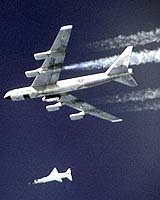
NASA's extremely successful X-43A hypersonic research aircraft flight of March 27, 2004, resulted in a treasure trove of the first actual scramjet flight data ever obtained. The initial data review of the flight was conducted on March 31, confirming that high-fidelity flight data was obtained throughout the vehicle's boost, stage separation and descent to splash down in the Pacific Ocean. "The data clearly shows, and without question, that scramjets work," said Griff Corpening, NASA Dryden Flight Research Center's X-43A chief engineer. "But we did see a couple of areas that differed from what was seen in the wind tunnels, thus reinforcing the need for flight testing," Corpening said. Two very significant aviation milestones occurred on this joint effort by NASA Langley Research Center, NASA Dryden, and their industry partners: First, controlled accelerating flight at Mach 7 under scramjet power, and second, the successful stage separation at high dynamic pressure of two non-axisymmetric vehicles. This was the first time an airbreathing scramjet-powered aircraft has flown freely. As icing on the cake that capped the mission's success, the flight resulted in the setting of a new aeronautical speed record. The X-43A reached a speed of over Mach 7, or about 5,000 mph, faster than any known aircraft powered by an airbreathing engine has ever flown. "We flew very closely to how we predicted we would fly in terms of Mach, dynamic pressure, vehicle angle of attack, vehicle yaw, and vehicle roll," Corpening said. The March 27 flight, originating from NASA's Dryden Flight Research Center, began with NASA's B-52B launch aircraft carrying the X-43A out to the test range over the Pacific Ocean off the California coast. The X-43A was boosted up to its test altitude of about 95,000 ft., where it separated from its modified Pegasus booster and flew freely under its own power. Planning is underway for the next flight, currently scheduled for this fall. The recent flight success allows engineers to zero in on where to focus their attention, allowing the Hyper-X team to move more quickly and with more confidence in preparing for the Mach 10 flight, Corpening added. Related Links Marshall Space Flight Center SpaceDaily Search SpaceDaily Subscribe To SpaceDaily Express  Door Opens For Hypersonic Flight
 by Irene Mona Klotz
Cape Canaveral (UPI) Mar 30, 2004 In a giant leap for aviation and aerospace, NASA has flown an experimental hypersonic jet that has shattered a four-decade-old record and proven for the first time an air-breathing engine can operate at more than five times the speed of sound.
|
|
| |||||||||
| The content herein, unless otherwise known to be public domain, are Copyright 1995-2016 - Space Media Network. All websites are published in Australia and are solely subject to Australian law and governed by Fair Use principals for news reporting and research purposes. AFP, UPI and IANS news wire stories are copyright Agence France-Presse, United Press International and Indo-Asia News Service. ESA news reports are copyright European Space Agency. All NASA sourced material is public domain. Additional copyrights may apply in whole or part to other bona fide parties. Advertising does not imply endorsement, agreement or approval of any opinions, statements or information provided by Space Media Network on any Web page published or hosted by Space Media Network. Privacy Statement All images and articles appearing on Space Media Network have been edited or digitally altered in some way. Any requests to remove copyright material will be acted upon in a timely and appropriate manner. Any attempt to extort money from Space Media Network will be ignored and reported to Australian Law Enforcement Agencies as a potential case of financial fraud involving the use of a telephonic carriage device or postal service. |