|
 |
 |
 |
 |
 |
 |
 |
 |
 |

| . |  |
. |
Japan Teams With France To Test Hope-X Test Vehicle
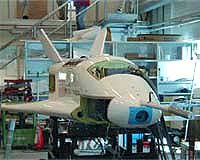
Starting from 6 June, the French space agency CNES began conducting several stratospheric balloon flights from the Kiruna launch base in Sweden for the purposes of a particularly innovative mission: to perform drop tests from an altitude of 30 kilometres on a flight prototype developed by NAL, the japanese aerospace laboratory, and NASDA, the Japanese space agency. The flight prototype is a 500-kilogram, quarter-scale model of Japan�s HOPE-X spaceplane. Each flight will take the prototype to an altitude of 30 kilometres on a CNES stratospheric balloon. The prototype will then be released in free fall and analysis will focus on the transonic flight phase between 20 and 10 kilometres, at which it will reach a speed of Mach 1. The flight will end with a soft parachute landing, cushioned by airbags. Japan and France will share the data gathered from the flight tests, and CNES intends to work with the French aerospace agency ONERA and industrial firms such as EADS and Dassault on the project. Three or four flights are planned, depending on weather conditions. This flight test campaign in Kiruna is scheduled to last from early June to mid-July, when atmospheric conditions are right to loft balloons to altitudes of around 30 kilometres and perform drop tests safely. This High Speed Flight Demonstrator 2 project (HSFD 2) was defined at the CNES/NASDA symposium in Tokyo, Japan, in February 1999, then in Paris, France, in June of the same year, within the framework of French-Japanese cooperation on future launch vehicles. The project will further strengthen partnership ties with Japan and allow both nations to acquire experience on a spacecraft built by Japan and launched by CNES, until Japan�s HOPE-X spaceplane project gets fully underway. NAL and NASDA have already completed subsonic flight tests with ALFLEX and hypersonic flight phases with HYFLEX, and have tested extreme aerodynamic heating with OREX and landing with HSFD 1 last automn. HSFD 2 aims to acquire data during the transonic flight phase that will help to refine system design tools and methodologies for controlling flight of re-entry vehicles with limited handling qualities during transonic flight regimes. CNES�s participation in HSFD 2 will enable significant progress towards this requirement, irrespective of the aerodynamic shape NAL/NASDA finally selects for the spaceplane. Cooperation will be achieved through in-kind exchanges, with NAL and NASDA developing the flight vehicle, and CNES�s balloon team managing the launch. In return, CNES will receive data from all flight tests. Related Links NASDA NAL CNES SpaceDaily Search SpaceDaily Subscribe To SpaceDaily Express  Contracts Issued For Automated Transfer Vehicle Control Centre
 Paris - Apr 17, 2003
On Thursday 17 April ESA Director of Human Spaceflight, Mr J�rg Feustel-B�echl, will sign a contract with the French space agency (CNES), represented by its President Yannick d'Escatha, for the development and operations of the Automated Transfer Vehicle Control Centre in Toulouse, France.
|
|
| |||||||||
| The content herein, unless otherwise known to be public domain, are Copyright 1995-2016 - Space Media Network. All websites are published in Australia and are solely subject to Australian law and governed by Fair Use principals for news reporting and research purposes. AFP, UPI and IANS news wire stories are copyright Agence France-Presse, United Press International and Indo-Asia News Service. ESA news reports are copyright European Space Agency. All NASA sourced material is public domain. Additional copyrights may apply in whole or part to other bona fide parties. Advertising does not imply endorsement, agreement or approval of any opinions, statements or information provided by Space Media Network on any Web page published or hosted by Space Media Network. Privacy Statement All images and articles appearing on Space Media Network have been edited or digitally altered in some way. Any requests to remove copyright material will be acted upon in a timely and appropriate manner. Any attempt to extort money from Space Media Network will be ignored and reported to Australian Law Enforcement Agencies as a potential case of financial fraud involving the use of a telephonic carriage device or postal service. |