|
 |
 |
 |
 |
 |
 |
 |
 |
 |

| . |  |
. |
World's Smallest Self-Propelled Satellite Set For Delivery To Air Force
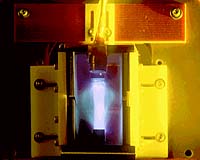
After three years of work, University of Washington students have nearly completed the world's smallest self-propelled satellite and are preparing to deliver it to the Air Force and NASA for launch. The nanosatellite, dubbed "Dawgstar" and tentatively scheduled for launch from the Space Shuttle in early 2003, will take samples from the Earth's ionosphere and conduct experiments in formation flying with two other satellites, an ability scientists say is vital for the next generation of space endeavors. But one of the best parts of the project is that students played a primary role in designing and building the compact piece of space hardware, according to Assistant Professor Mark Campbell, coordinator of the effort. "It's very unusual for students, particularly undergraduates, to have an opportunity to work on something that is actually going into space," said Campbell, who recently left the UW for Cornell University in Ithaca, N.Y., and is coordinating the final stages of the project long-distance. "This isn't a class exercise -- it's the real thing and they're getting great experience by being part of it." The nanosatellite project is intended to encourage universities to work together to explore low-cost alternatives to large, expensive satellites. Nanosatellites, because of their small size, are cheaper to build. Their low weight makes for less expensive launches -- a major factor, considering that the cost of a Space Shuttle launch starts at about $1 million. Launches aboard unmanned vehicles are even costlier. Dawgstar resembles a small six-sided box, measuring 18 inches across and 12 inches high, and weighing less than 40 pounds. It will fly with companion satellites from Utah State University and Virginia Tech. Dawgstar, with the aid of eight tiny plasma thrusters, is the primary craft capable of maneuvering itself. The Virginia Tech craft, which is larger than Dawgstar, will fly with two thrusters built by the UW team, providing partial mobility. The mission's two main objectives are:
Related Links Dawgstar SpaceDaily Search SpaceDaily Subscribe To SpaceDaily Express  Surrey-built PICOSat launched for US Air Force
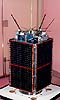 Guildford - Oct 1, 2001
PICOSat, a 67kg microsatellite developed for the US Air Force (USAF) Space Test Program (STP) by Surrey Satellite Technology Limited (SSTL) in the UK, was launched successfully from Alaska on 30th September.
|
|
| |||||||||
| The content herein, unless otherwise known to be public domain, are Copyright 1995-2016 - Space Media Network. All websites are published in Australia and are solely subject to Australian law and governed by Fair Use principals for news reporting and research purposes. AFP, UPI and IANS news wire stories are copyright Agence France-Presse, United Press International and Indo-Asia News Service. ESA news reports are copyright European Space Agency. All NASA sourced material is public domain. Additional copyrights may apply in whole or part to other bona fide parties. Advertising does not imply endorsement, agreement or approval of any opinions, statements or information provided by Space Media Network on any Web page published or hosted by Space Media Network. Privacy Statement All images and articles appearing on Space Media Network have been edited or digitally altered in some way. Any requests to remove copyright material will be acted upon in a timely and appropriate manner. Any attempt to extort money from Space Media Network will be ignored and reported to Australian Law Enforcement Agencies as a potential case of financial fraud involving the use of a telephonic carriage device or postal service. |