|
 |
 |
 |
 |
 |
 |
 |
 |
 |

| . |  |
. |
Iran Adds To International Worries With Bigger Range Missile
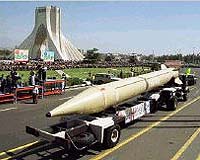
Iran declared Tuesday it had ballistic missiles with a range of 2,000 kilometres (1,240 miles), and could produce ones with a greater range, an announcement likely to add to international concerns over its weapons capabilities. "Today, we have the power to send our missiles up to 2,000 kilometres, and experts know that once a country has made such a step, all further steps are accessible," former president Akbar Hashemi Rafsanjani was quoted as saying by the official news agency IRNA. Steady progress made by Iran's ballistic missile programme is a major cause for concern for the international community, already alarmed over the country's suspect nuclear activities. "We have today the ballistic technology and if we had not limited our progress, we would have been even more advanced," Rafsanjani told a conference on "Space and National Security". "With this ballistic power, we can today speak of an independent satellite launch and we should seek the technology to make our own satellites," he added, saying Iran was "at the door of the club of countries having satellite technology." Iran has previously announced it hopes to launch its first satellite, for telecommunications, in 2005. On August 11, Iran tested an upgraded version of its Shahab-3 missile. Previous figures had put the missile's range at between 1,300 and 1,700 kilometres, already bringing arch enemy Israel and US bases in the region well within range. After the latest test, Israeli news reports put the range of the new Shahab-3 - believed to be based on a North Korean design - at 2,000 kilometres. And during a military parade last month, Iran showed off its array of ballistic missiles draped in banners vowing to "crush America" and "wipe Israel off the map". "The Shahab-3 missiles, with its different ranges, enables us to destroy the most distant targets," said an official commentary accompanying the parade. While the country has announced it has upgraded the Shahab-3, it has denied it is working on a Shahab-4 - a device that would involve a two-stage propulsion system and possibly bring European capitals within range. But such assertions have failed to ease alarm among many European officials, and last week the government said it was being deliberately ambiguous over its missile capability. That comment came after Defence Minister Ali Shamkhani told state-run television that the Iranian army had taken delivery of a new "strategic missile" and that the weapon, unnamed for security reasons, had been successfully tested. Iran insists the Shahab-3 is simply a deterrent, while Israel charges that the Islamic state could have a nuclear warhead by 2007. Israeli alarm has led to speculation that the Jewish state - currently believed to be the only nuclear-armed nation in the Middle East - may launch a pre-emptive strike against Iran's nuclear facilities. But Rafsanjani, who now heads the Expediency Council - Iran's top political arbitration body - dismissed such a threat. "The United States and the Zionist regime are our enemies, but given their past experience, the United States knows that they should not engage themselves in a dangerous conflict with us," he said. All rights reserved. � 2004 Agence France-Presse. Sections of the information displayed on this page (dispatches, photographs, logos) are protected by intellectual property rights owned by Agence France-Presse. As a consequence, you may not copy, reproduce, modify, transmit, publish, display or in any way commercially exploit any of the content of this section without the prior written consent of Agence France-Presse. Related Links SpaceDaily Search SpaceDaily Subscribe To SpaceDaily Express  General Dynamics APKWS Guided Rocket Completes 5th Flight Test
 Charlotte NC (SPX) Sep 29, 2004
General Dynamics Armament and Technical Products, a business unit of General Dynamics, announced today that on Sept. 10 its Advanced Precision Kill Weapon System (APKWS) 70mm guided rocket successfully completed its fifth flight test. This was the latest in a series of flight tests that began in 2002 during an advanced technology demonstration project to demonstrate the basic design's effectiveness over the operational range.
|
|
| |||||||||
| The content herein, unless otherwise known to be public domain, are Copyright 1995-2016 - Space Media Network. All websites are published in Australia and are solely subject to Australian law and governed by Fair Use principals for news reporting and research purposes. AFP, UPI and IANS news wire stories are copyright Agence France-Presse, United Press International and Indo-Asia News Service. ESA news reports are copyright European Space Agency. All NASA sourced material is public domain. Additional copyrights may apply in whole or part to other bona fide parties. Advertising does not imply endorsement, agreement or approval of any opinions, statements or information provided by Space Media Network on any Web page published or hosted by Space Media Network. Privacy Statement All images and articles appearing on Space Media Network have been edited or digitally altered in some way. Any requests to remove copyright material will be acted upon in a timely and appropriate manner. Any attempt to extort money from Space Media Network will be ignored and reported to Australian Law Enforcement Agencies as a potential case of financial fraud involving the use of a telephonic carriage device or postal service. |