|
 |
 |
 |
 |
 |
 |
 |
 |
 |

| . |  |
. |
Russia Says Game Over For Mir
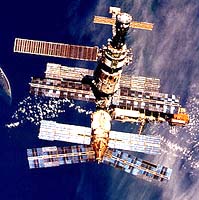
Moscow (AFP) Oct. 23,2000 The Mir space station will be cast into a watery grave in February 2001 a senior Russian minister said Monday, as Moscow signalled it was ready to pull the financial plug on a 14-year odyssey. "We expect to bring down Mir in the ocean by the end of February," said Deputy Prime Minister Ilya Klebanov, adding that an official government decision would be announced shortly. Cash proved to be the final frontier for the Soviet-build orbiter, which despite an uncertain safety record has accumulated more space records than its better-equipped, better-financed US rivals. For Russia is already struggling to meet its financial commitments to the International Space Station, a project backed by 16 nations which is due for completion by 2005. Possibly days after celebrating its 15th birthday, the ageing craft will begin a controlled descent into the Earth's atmosphere, causing much of the 130-tonne vessel to burn up on re-entry. The rest will make a spectacular plunge into the Pacific Ocean. A Progress supply ship is due to blast off for Mir in February next year to prepare the veteran orbiter for its final days. Klebanov's comments come after the government was forced to step in this month to send a supply ship to Mir to prevent it from making an uncontrolled arrival back on planet Earth. MirCorp, the consortium fighting to drum up private-sector funds to give Mir a commercial lease of life, said the dispatch of the supply vessel had come earlier than planned, blaming solar flares for the foul up. CEO Jeffrey Manber told AFP that the Dutch-based outfit would make good the launch cost, put at some 20 million dollars, in November. In the meantime, Klebanov's comments were "not helpful" as MirCorp had secured enough funds to keep Mir in space for at least one more year, he said. President Vladimir Putin might not yet take a final decision on Mir's fate for another two weeks, he added. "The frustrating thing for us ... is we do have the funds but we need their help to get us through the next few months," Manber said of the Russian government. "Let us pay for this progress, keep the Mir in orbit, and then the next funds will come," he said. The company had already 100 million dollars pledged for 2001 and expected to raise 117 million dollar through an initial public offering on stock exchanges in New York, Singapore, London or Frankfurt, which would secure funding for 2002. He put Mir's running costs in 2001 at about 70 million dollars, rising to 125 million dollars in 2002 when the station is due to be manned on a permanent basis. "If the Russian government lets us get through this period we have the funds for next year and the IPO gives us the funds for 2002. "The Mir is then healthy again, permanently manned, and we can go on doing the marvellous things we're doing and funding Russia's production line," he said. But Sergei Gorbunov, spokesman for the Russian Space Agency, dismissed Manber's enthusiasm. "MirCorp's statements remain just that -- statements. But where's the money? We can't wait for Mir to fall on our heads. "The last Progress flight was financed by the Russian government in breach of all our undertakings," he said. Russia has pledged to devote its space budget to the ISS and keep Mir in space using only private cash. "The state was forced to do this in order to prevent an accident," he said. Related Links SpaceDaily Search SpaceDaily Subscribe To SpaceDaily Express  Russia Considering Three Options For Sinking Mir
 Moscow (AFP) Oct. 23, 2000
Russia's Soviet-era space station Mir will be terminated in late February 2001, Russian Deputy Prime Minister Ilya Klebanov said Monday, Interfax reported. The ageing space craft will be taken out of orbit and allowed to burn up in the Earth's atmosphere, the remainder falling into one of the Earth's oceans, the agency quoted Klebanov as saying.
|
|
| |||||||||
| The content herein, unless otherwise known to be public domain, are Copyright 1995-2016 - Space Media Network. All websites are published in Australia and are solely subject to Australian law and governed by Fair Use principals for news reporting and research purposes. AFP, UPI and IANS news wire stories are copyright Agence France-Presse, United Press International and Indo-Asia News Service. ESA news reports are copyright European Space Agency. All NASA sourced material is public domain. Additional copyrights may apply in whole or part to other bona fide parties. Advertising does not imply endorsement, agreement or approval of any opinions, statements or information provided by Space Media Network on any Web page published or hosted by Space Media Network. Privacy Statement All images and articles appearing on Space Media Network have been edited or digitally altered in some way. Any requests to remove copyright material will be acted upon in a timely and appropriate manner. Any attempt to extort money from Space Media Network will be ignored and reported to Australian Law Enforcement Agencies as a potential case of financial fraud involving the use of a telephonic carriage device or postal service. |